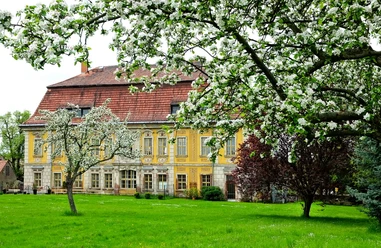
Kössern hunting lodge


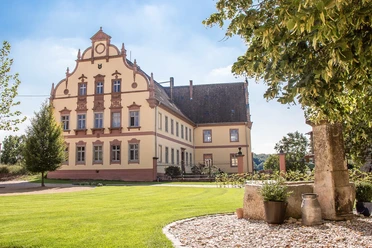
Built in the style of a large manor house around 1709, the hunting lodge - often referred to as a hunting lodge - is considered an outstanding gem of Baroque architecture in the Mulde Valley. The architect was Matthäus Daniel Pöppelmann, chief court huntsman and elder minister in the cabinet of the Saxon Elector Frederick Augustus I and later King of Poland Augustus II - known as "Augustus the Strong".
The high mansard roof greets visitors from afar. The tightly structured, richly painted façade presents itself in perfect harmony. The foyer on the first floor was supported on both sides by four strong pillars to allow a view of the Great Garden.
A grand staircase, preserved in its original form, leads to the upper floor with a surprisingly stately ballroom, crowned by lavish stucco and a large ceiling painting.
Today, guided tours in historical costume, concerts, events and rooms for weddings are offered. There is also a tourist information point in the Kössern hunting lodge, which is located directly on the Mulde cycle path.
The high mansard roof greets visitors from afar. The tightly structured, richly painted façade presents itself in perfect harmony. The foyer on the first floor was supported on both sides by four strong pillars to allow a view of the Great Garden.
A grand staircase, preserved in its original form, leads to the upper floor with a surprisingly stately ballroom, crowned by lavish stucco and a large ceiling painting.
Today, guided tours in historical costume, concerts, events and rooms for weddings are offered. There is also a tourist information point in the Kössern hunting lodge, which is located directly on the Mulde cycle path.
Good to know
Organization
Leipzig Tourismus und Marketing GmbH
License (master data)
Leipzig Tourismus und Marketing GmbH