The complete Music Arc will run for approximately seven kilometres; the first phase – the roughly five-kilometre northern route – comprises 13 of a planned 19 stations, while the southern section, with a further six stations, will follow in 2027. The opening forms part of the 2026 theme year TACHELES. Year of Jewish Culture in Saxony. The Leipzig Music Arc will be inaugurated as a new themed walking route within the European Routes of Jewish Heritage, a Cultural Route of the Council of Europe.
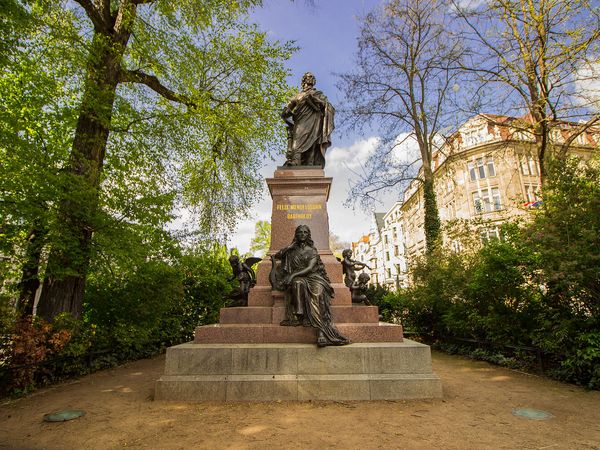
Conceived as a complement to the existing Leipzig Music Trail (Leipziger Notenspur), the Leipzig Music Arc extends the city’s musical heritage beyond the historic centre into its western Gründerzeit-era districts. It traces Leipzig’s development as a centre of Romanticism, Late Romanticism and early Modernism. The northern route highlights the contributions of Jewish residents to Leipzig’s musical and civic life from the nineteenth century onwards, following the return of Jewish communities after their medieval expulsion. It links former synagogue sites with residences and memorials associated with composers including Felix Mendelssohn Bartholdy, Gustav Mahler and Erwin Schulhoff. Each station provides access to curated musical excerpts and short audio features, allowing visitors to encounter the intertwined histories of Jewish and non-Jewish musical and cultural life in Leipzig. Route details and station descriptions are available at: https://www.notenspur-leipzig.de/en/music-routes/leipzig-music-arc/route-and-stations
The inauguration on 6 September will be marked by a promenade concert starting at the former site of the Ez Chaim Synagogue at 11 am, culminating in a ceremonial event at Höfe am Brühl, entrance Richard-Wagner-Platz, at 1 pm. The synagogue, inaugurated in 1922 and destroyed during the November pogrom of 1938, was once Saxony’s largest Orthodox synagogue. It served a growing Orthodox community that included Jewish migrants and people fleeing pogrom violence in Eastern Europe. Today the site features commemorative elements, including a large banner and a sound installation, initiated and implemented by the Notenspur Leipzig e. V. (Leipzig Music Trail Association). Historical cantorial recordings, including those of Chief Cantor Nahum Wilkomirsky, are interwoven with contemporary cello compositions and student audio projects, transforming what is today a parking area into a place of reflection.
About the Leipzig Music Trail Network
The Leipzig Music Trail links 23 principal sites of musical history within Leipzig’s city centre along a five-kilometre route. Opened in 2012, it is marked by a continuous line of curved stainless-steel inlays set into the pavement, accompanied by information panels at each location. The trail connects churches, concert halls, publishers’ premises and former residences in a density that reflects Leipzig’s exceptional role in European music history. Past and present intersect at close quarters: the historical foundations of the city’s musical life remain visible, while institutions and ensembles continue to shape its contemporary profile.
In the coming years, the network is set to expand further with the planned Leipzig Music Bike Trail (Leipziger Notenrad). The Leipzig Music Path (Leipziger Notenweg) is already accessible as an approximately eight-kilometre walking route. It does not have a physical signage system; however, a flyer, map with GPS data and descriptions of all stations are available online at: https://www.notenspur-leipzig.de/en/music-routes/leipzig-music-path/route-and-stations
The City of Leipzig is also applying to join the UNESCO Creative Cities Network as a "City of Music”.
Further Information:
https://www.notenspur-leipzig.de/en
https://www.leipzig.travel/cityofmusic