Dr Heine and his visions for the Plagwitz district
German entrepreneurship is closely linked to the history of Plagwitz. One influential industrialist in Germany was the landowner’s son and lawyer Dr Carl Erdmann Heine (1819–88). It was thanks to his hard work that between 1840 and 1880 Leipzig spearheaded the process of German industrialisation. Dr Heine was deeply impressed by the still revolutionary railway and the economic use of waterways – and in fact when Plagwitz-Lindenau station opened in 1873 it was the first industrial railway station anywhere in Europe. Dr Heine bought up large meadows and farmland in Plagwitz and used them to build housing and factories. He drained the swampy land and regulated the watercourses. Dr Heine also worked hard to attract industrial companies to Plagwitz, making sure they were integrated into the rail and canal networks. The combination of housing and jobs was unique, and in combination with the ideal transport links triggered an industrial boom.
Heine’s visions included digging a canal which was intended to be part of a shipping route from Leipzig to Hamburg. The aim behind it was to be able to export industrial goods produced in Leipzig all over the world via the port of Hamburg. With the connection of Lindenau Harbour to Karl Heine Canal and the Elster Saale Canal, this vision became reality – although only for private boats and water sports enthusiasts. Boating on the reopened waterways is already part of everyday life in and around Leipzig.
In combination with connecting the Leipzig region to the River Saale, the water landscape evolving to the south of Leipzig offers a unique opportunity to build up a previously inconceivable water tourism sector in the region.
Starting in 1920, business activities in Plagwitz began to fall off as a result of first the arms industry and stock market speculation followed by war and the economic decline of the socialist command economy. Although largely unscathed during World War II, Plagwitz’s industrial output finally ground to a halt when East Germany collapsed in 1989. Nearly one and a half centuries of production were brought to a stop by rapid deindustrialisation. The local plants were shut down, much of the population migrated elsewhere, the quantity of vacant housing mushroomed, and many buildings were demolished. Over 90,000 industrial jobs were lost in Leipzig at this time, many of them in Plagwitz. The borough was written off and seemed doomed to decay. Its image became dominated by eerie houses, empty factory buildings, overgrown railway lines and polluted canals. Once again, fresh visions were needed – and a new period of entrepreneurship. The architectural monuments along with the canals and the railways which together made up Plagwitz’s unique charm had to be cleaned up and restored. Thus it was that Leipzig City Council and numerous investors set to work on an extensive development programme.
From vacancy to creative hub
In the year 2000, Plagwitz was a corresponding site of the EXPO 2000 world’s fair in Hanover under the slogan: ”Plagwitz on the road to the 21st century – a borough is transformed”. The attention generated all over the world gave fresh momentum to Plagwitz’s development. Since then, several companies have taken root in Plagwitz, including many from the creative sector, such as the renowned start-up Spreadshirt.
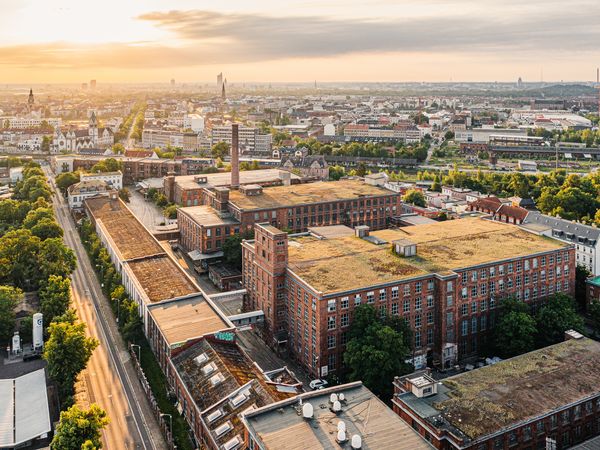
Fortunately, most of the architectural ensembles dating back to the Industrial Era in the 19th century and the early modern age survived the difficult years. Following restoration, they are now blossoming with all the fascination of a lost world. Nowadays, the magnificent brick buildings and the impressive bridges spanning the Karl Heine Canal once designed to turn Leipzig into a port that can be reverently admired. Some of the disused factories contain exclusive loft apartments, while elaborate root-heating systems in the courtyards allow exotic palms to flourish.
One of the main attractions in Plagwitz and the neighbouring district of Lindenau is the Spinnerei. Formerly the largest cotton mill of continental Europe, the Spinnerei is now home to galleries, exhibition halls and artist studios. Those interested in the industrial buildings erected and operated in Plagwitz in quick succession until the end of East Germany in 1989 will encounter some striking examples. The architectural gems include Titel & Krüger’s 1866 woollen yarn factory (Nonnenstrasse/ Elsterstrasseand), and the Konsum headquarters designed by Hamburg architect Fritz Höger and built in 1928 (Industriestrasse 85–95) – a superb symbiosis of brick expressionism and new functionalism. Other examples include Unruh & Liebig’s machine plant founded in 1880 (Naumburger Strasse 28) and the coloured yarn works built between 1879 and 1925 on Nonnenstrasse – one of the largest Industrial Era monuments in Germany.
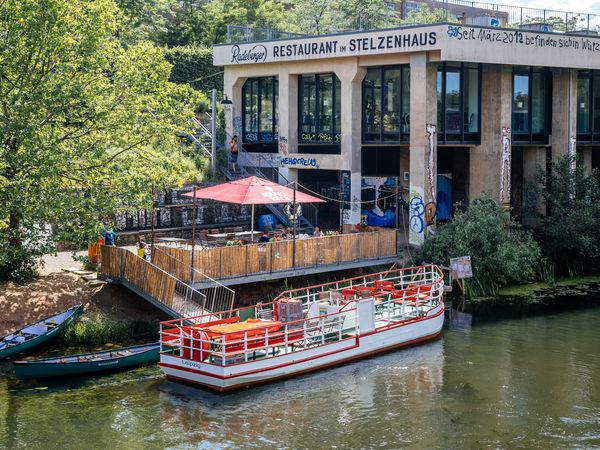
Anyone taking a boat tour along the Karl Heine Canal can’t fail to notice Stelzenhaus – the ”house on stilts” on Weissenfelser Strasse. It was originally built in the late 19th century as a corrugating sheet rolling mill owned by Grohmann & Frosch.
Owing to the lack of space, this strictly functionalist building was erected on massive concrete pillars on a bend in the canal. Following conversion, it was reopened in 2003 and now houses a fashionable restaurant with a great view onto the canal. From the little dock underneath, you can start a boat tour with the MS Weltfrieden: This indestructible excursion cruiser on Leipzig's Venetian-like canal network is a small motor boat with an ambitious name. As it chugs along the Karl Heine Canal and Elster river it passes under 16 bridges and past the MDR-Riverboat, the colourful Buntgarnwerke (Germany's largest industrial monument), the Karl Heine Villa, and on to industrial charm and idyllic shores.
Plagwitz’s development from a village into an industrial area can be divided into four separate eras: industrialisation in 1840–70, world trade and the boom in new businesses in 1870–1918, the world economic crisis and war machinery in 1920–45, and a post-war new beginning as an industrial district followed by its rise and fall in 1945–89. The resulting industrial wasteland has since been transformed into a modern, green, socially sustainable and desirable district for housing, work and leisure which is unique in Germany.
Further Information
www.leipzig.travel/en
www.leipzig.travel/en/discover/music-and-culture/industrial-heritage