Das Grafische Viertel (The Graphic Quarter)
The so-called Grafische Viertel (graphic quarter) in Leipzig contributed significantly to the development of Leipzig as a book metropolis before the Second World War. Located east of the city centre, in what is now Zentrum Ost, Reudnitz and Thonberg, most of the trade companies settled. Well-known companies such as Brockhaus, Teubner, Insel and Reclam built impressive industrial palaces. In 1913 alone, the Leipzig city directory listed more than 2.000 companies from all branches of the book trade, including 848 publishers and bookshops, 201 bookbinderies and 189 printers. This concentration in one quarter was unique in the world. The proximity of the various companies to one another was additionally a logistical advantage. Almost all German books were traded through Leipzig: the publishers based there had most books in stock at all times and were able to process them quickly and inexpensively. When the Eilenburg train station was opened in 1874 on the site of today's Lene Voigt Park, it not only made it easier to transport paper, machines and metal, but also to send books all over the world. Ten percent of Leipzig's population worked in publishing at that time.
However, the Second World War also left its mark on Leipzig. A major air raid carried out by British bombers on the night of December 3rd to 4th, 1943 left large parts of the city in ruins including the city centre and the neighbouring districts such as the Grafische Viertel (Graphic Quarter). Following the attacks, the large-scale fires caused by the bombardment created a firestorm. It is estimated that around 50 million books were destroyed, and 1.000 companies were destroyed that night. After 1945, many publishers emigrated to West Germany as a result of a wave of expropriations or set up branches there. Only around 50 publishers remained in Leipzig during the GDR era.
Today, numerous representative buildings still bear witness to the splendour of that time. With the opening of the "House of Books" in 1996, the district once again became a lively meeting place.
The Leipzig Book Fair as a magnet for visitors
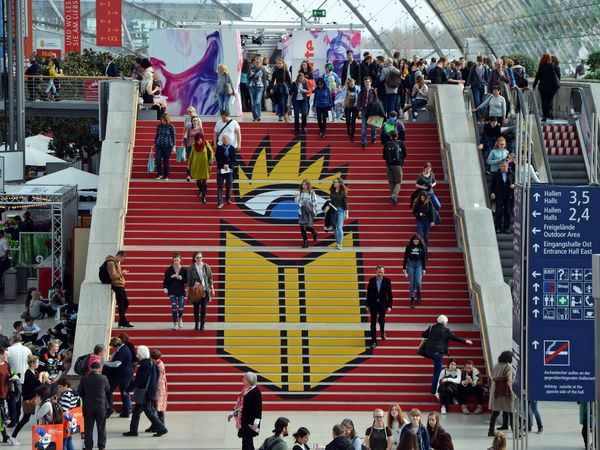
The Leipzig Book Fair, together with the "Leipzig liest" festival (Leipzig Reads Festival), marks the start of the industry year in Leipzig every year. After Frankfurt am Main, the event in Leipzig is the second largest book fair in Germany. Its history stretches back to the 17th century, when the number of books presented at the fair exceeded that of the Frankfurt fair for the first time. Due to the fact that many publishers are based in Leipzig and that access is unlimited for everyone, the fair has established itself as a real crowd puller. In addition to presentations of new releases, readings by well-known authors and impulses for the book market, the public fair is also held in conjunction with the Leipzig Antiquarian Book Fair and the Manga Comic Convention. The Leipzig Book Fair Prize and the Leipzig Book Prize for European Understanding are also awarded as part of the supporting program. The nominations for the German Youth Literature Prize are also announced at the book fair.
“Leipzig liest” has been Europe’s largest reading festival for 30 years. Numerous events in the centre of Leipzig offer the opportunity to listen to well-known personalities from the book industry and to come into contact with them. During this event, the entire city is transformed into a single reading stage.
Eternal Knowledge – Leipzig's Libraries
In the city of books, libraries are a must. The most famous is the German National Library (DNB), founded on October 3, 1912, at the instigation of the German Booksellers' Association in Leipzig. After the division of Germany, a German library was also founded in Frankfurt am Main in 1947. The two libraries were merged on October 3, 1990. The two locations' archives contain around 41 million media units, of which around 9,3 million are online publications - making them the central archive library in Germany.
The building, which was constructed between 1914 and 1916, was expanded from 1934 to 1936 and from 1959 to 1963. The functional book tower was built between 1976 and 1982. The DNB's mandate to collect and permanently preserve German and German-language publications led to a constantly increasing need for space. For this reason, when planning the first construction phase, the architect Oskar Pusch planned to expand the building at regular intervals. When the German Music Archive moved from Berlin to Leipzig in 2010, around 1,5 million musical and sound recordings were added.
An extraordinary library is located in the Musikviertel (Music Quarter): The Bibliotheca Albertina was built in the neo-renaissance style between 1887 and 1891 based on a design by Arwed Roßbach. After reconstruction in the 20th century, the entire building complex was extensively modernized between 1992 and 2002. As a centre for literature acquisition and cataloguing and as an archive library, it is an important part of the University of Leipzig. Named after the former sovereign King Albert of Saxony, the library has more than 5,5 million volumes and 6.500 current journals. In addition, 173.000 autographs, 80.000 coins and medals as well as a papyrus and ostraca collection are housed in the premises - including one of the oldest medical documents in the world, the Ebers Papyrus.
Founded in 1894, the German Center for Accessible Reading (DZB) is the oldest public library for the blind in Germany. Around 80.000 titles from all literary genres are available for loan in the form of audio and Braille media, large print or sheet music. The institution thus makes a significant contribution to expanding educational opportunities for visually impaired people. The DZB is not primarily designed as a library, but as a production centre for media for people with reading disabilities. The centre also supports numerous institutions in creating barrier-free communication and information services.
Additionally, the Leipzig City Library at Wilhelm-Leuschner-Platz is one of the most popular cultural institutions in the city. Originally opened as the Leipzig City Library in 1711, it was renamed the "Bibliotheca Senatus Lipsiensis" (Leipzig City Library) in 1832 and over the years it set up 15 different branches in the districts of Leipzig. Today, the city libraries are important centres for communication, information, reading promotion and education. A special feature is the mobile library: since 2012, the bus has been providing readers throughout the city with a wide range of media.
In 1990, the women's library MONAliesA was founded. The institution aims to promote the education of women and feminist culture and offers professional archive, library, educational and cultural work. Over time, the collection has grown to more than 30.000 media units on the topics of women, girls, gender and feminism. This makes MONAliesA one of the most important feminist specialist libraries in Central Germany and is also a pilot project for women's policy.
The topic of environmental protection is a priority for the Leipzig Environmental Library. Founded in 1988 by the Ökolöwe – Umweltverbund Leipzig eV, the institution offers a stock of around 9.100 media.
A different focus is set by the Central Geographical Library of the Leibniz Institute for Regional Geography eV. As one of the largest geographical specialist libraries in Germany, it has a collection of around 60.000 maps as well as historical books and atlases. The library is therefore a relevant institution for scientists to continue their education in the fields of human geography, spatial planning, physical geography or regional history.
Leipzig as the birthplace of authors
Anyone who has the dream of becoming an author cannot ignore Leipzig. German Literature Institute Leipzig (DLL) is the only institution in Germany, apart from Hildesheim, to offer a university-based training course for writers. Founded in 1955, the institution was once known as the "Johannes R. Becher Institute". Since then, around 1.000 authors have been trained there. After the fall of the Berlin Wall and the threat of closure, the institute became part of the University of Leipzig, and its continued existence was assured. Well-known German authors such as Bas Böttcher, Juli Zeh and Heiner Boehncke are among the lecturers.
Since 2008, there has also been another training institution for writers in Leipzig: the Textmanufaktur. The state-recognized educational institution offers a wide range of opportunities to expand knowledge of the art of writing, from writing seminars to distance learning for writers.
Thanks to the intensive networking of the University of Leipzig with the publishing and media industry, the courses “Book Studies” and “Publishing Production” at the HTWK achieve a high placement rate in the publishing industry. Leipzig not only trains the writing side, but also the publishing side. The heart of book studies at the University of Leipzig is the “Bibliotop“. Since 2021, a unique collection of works by the publishers Insel, Reclam and Co. as well as 3.000 works on the history of the book trade, bibliophilia and typography has been shining in the vault of the former Commerzbank in the premises on Ritterstraße.
Well-known writers
As the cradle of the book trade, Leipzig was home to numerous literary figures. In addition to Johann Christoph Gottsched, who founded the first German literary magazine in 1732, Christian Fürchtegott Gellert was also able to enjoy the great popularity of his works. As a former student in Leipzig, Gotthold Ephraim Lessing also wrote his famous work "Der junge Gelehrte" (The Young Scholar) in 1746, which was performed two years later by the Neuberschen Theatertruppe (Neubersche Theatre Troupe) in Leipzig. Friedrich Gottlieb Kloppstock came to the trade fair city to study in 1746. Inseparably linked to Leipzig is Johann Wolfgang Goethe. In 1765 he came to Leipzig to study and was so moved by the legend of Auerbachs Keller that he ultimately included the wine cellar in his drama Faust I. The travel writer Gottfried Seume lived in Knautkleeberg from 1770 and attended the Nikolaischule until 1780. Christian Felix Weiße became known as a pioneer of German children's literature in 1775. With his weekly magazine “Der Kinderfreund”, he shaped the educational landscape. Other well-known students at the University of Leipzig were Jean Paul, who wrote his first work in the inn “Zu den drei Rosen”, as well as Novalis – the famous poet of the Romantic period. Friedrich Schiller came to Leipzig in 1785 and wrote his “Ode an die Freude” (Ode to Joy) in the Schiller House in Gohlis, which is now named after him. Theodor Körner, Theodor Fontane and Friedrich Nietzsche shaped the city’s literary scene with their works in the 19th century. Lene Voigt, a dialect poet born in Leipzig, is still known today for her poems such as “Säk'sche Balladen”. In 1910, Erich Kaestner travelled to Leipzig and wrote articles for the Leipziger Tageblatt, among others. Two years later, Franz Kafka followed and met the publisher Ernst Rowohlt in “Wilhelms Weinstuben”. As a result of this meeting, Kafka’s first work "Betrachtung" (Contemplation) was published in 1912. In the new millennium, Clemens Meyer became particularly well known in 2006 with his impressive debut novel “Als wir träumten” (When we dreamed), which portrayed the period of reunification in Germany.
The Chronicle of the Book City of Leipzig
1475
Two booksellers from Basel and Ulm concluded a book deal at the autumn fair. This was the beginning of the book trade in Leipzig.
1481
On behalf of the Dominicans, the traveling printer Marcus Brandis printed the first book in Leipzig using movable type. It was the Latin script “Glosse in Apocalypsi”.
1485
Konrad Kachelofen was the first printer to settle in Leipzig. His first documented print is dated 1485.
1493
For the first time, a “book fair” was held, to which foreign booksellers also came to Leipzig.
1499
Melchior Lotter took over the printing business from Konrad Kachelofen. Martin Luther, who stayed with him during the Leipzig Disputation, had a great influence on his work. After 1517 he printed Luther's 95 theses, among other things, on posters.
1543
Caspar Borner laid the foundation stone for the university library. He succeeded in securing books from the dissolved monasteries.
1599
Henning Groß published the first book fair catalogue.
1682
With the “Acta Eruditorum” Otto Mencke founded the first German scholarly journal.
1701
The first Leipzig address book, “Das ietzlebende Leipzig”, was published, and was also the first of its kind in Germany.
1825
The German Booksellers’ Association in Leipzig was founded on 30.04.
1867
With Goethe’s “Faust”, the first paperback was added to Reclam's Universal Library on 10.11.
1887
The Booksellers’ Training Institute was officially opened on 29.04.
1927
The first International Book Art Exhibition (iba) was organized on the initiative of Hugo Steiner-Prag from 28.5.-30.9.
1948
The Buchhaus Leipzig opened as the central institution of the GDR mail order book trade
1991
For the first time, “Leipzig liest”, Europe’s largest reading festival, was held as part of the book fair.
Further Information