Historical city walk through Grimma

- 0:25 h
- 1.85 km
- 6 m
- 6 m
- 127 m
- 132 m
- 5 m
- Start: Town Hall
- Destination: Market
The Grimma Monument Circular Route leads you to some of the most historically and architecturally interesting buildings in the city center. Due to its compact spatial extent and clear signage, it provides an informative insight in a relatively short time – a plus for visitors pressed for time!

Good to know
Pavements
- Unknown (1%)Asphalt (99%)
Best to visit
- suitableDepends on weather
Directions
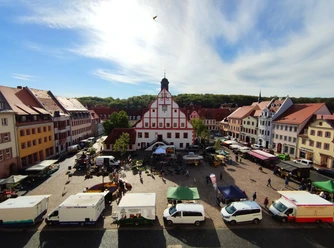
We begin our walk in the heart of the city, at Grimma Market Square:
Town Hall
The current town hall is considered to be the third on the new market square.
The construction period of the first town hall dates back to the late 13th century.
It was completely destroyed in the city fire of 1305. The second town hall was completed by about 1360. The third was built around 1440. The lower town area was raised due to flooding of the Mulde River and the massive basement of the predecessor was converted into a cellar.
After the fire of 1540, the west gable was renewed in Renaissance style. The timber-framed gable from 1441 on the east side remained. The stairs to the hall were rebuilt in 1585 as a covered external staircase.
The town hall always had a roof turret, which still bears a weather vane in the shape of an angel today.
The extension at the northwest corner dates back to 1782. The rooms were used by the Grimma hussars and later by the police as a guardhouse.
Since 1952 they have served as an art house.
The town hall was extensively restored from 1995 to 2000.
The view sways over the current town hall gallery to the left. The next information panel is located at the residential building Markt 10.
Markt 10
The former "Böhla Free House", a large, simple Baroque building, has served since 1783 as the city residence of the lords of Döben Castle. It was exempt from taxes and military quartering.
Immediately to the left is a porphyry memorial plaque reminding of Göschen's printing house. Our companion Seume also worked for four years in house Markt 11 as a proofreader and friend of the classical publisher.
Markt 11
The Seume House is a Renaissance building from 1521. The oldest house on the market is decorated by a two-story bay window with spiral and folded decoration made of Rochlitz porphyry tuff. Late Gothic ceilings and wall paintings can be viewed.
It might come as a surprise that Grimma's savings bank also has a connection with Göschen: The publisher was one of the initiators of the founding of the local savings bank in 1826, in front of whose side entrance – a few steps further to the left – we now stand.
Markt 13
The savings bank, built in 1929/30 on the site of two small houses according to plans by Hugo Koch, is the youngest building on the market.
The exemplary functional building is still in use today and is exemplary for functionally appropriate architecture.
We turn the corner to the main entrance of the savings bank building. Perhaps we will take a look into the foyer, then turn around and look at the striking bay window of Markt 14.
Markt 14
The wide Renaissance building from the 16th century served as a farmer's courtyard and housed an inn with a resting place. The younger corner bay made of wood rests on figurative console stones. The house was known in Grimma as "Hasenbein's inn".
Even today, we could go up to the first floor for a refreshment – or perhaps we'll save the restaurant visit until after the end of the tour. On the other side of the market alley leading to Nicolaiplatz, we turn to a house where one can stylishly tie the knot: The two rings already point to this at the entrance!
Markt 15
Amtmann Lüder had the beautiful Renaissance house built around 1572.
A splendid alliance coat of arms adorns the seating niche portal. The stair tower with its stone spiral staircase and the painted wooden ceiling in the foyer of today's registry office were restored until 2003.
The Café Winkler, responsible for wedding cakes and other sweets, was located to the left of the two city administration buildings (Markt 16/17) – also historically interesting. The fact that the enema syringe had previously been a trademark of the house has absolutely no connection with the confectionery – whose business was good...
Markt 18
In this Renaissance building, around 1800, was the workshop of G.C.I. Weber, who held the monopoly for the sale of tin enema syringes. The facade is decorated with neoclassical palmettes.
From 1894 Hermann Winkler operated a then well-known café here.
A golden lion adorns the gate entrance of Markt 19. It once gave its name to the oldest Grimma inn. We now walk along the south side of the market and come to a striking Baroque house, whose white facade draws the eye.
Markt 23
The wig maker Johann Gottfried Berger had the house rebuilt after a city fire according to the spirit of the times in 1739/40, among other things with the characteristic bay window. Subsequently, it was used by various merchants and traders and has served as the tourist office/city information since 2014, after 1990.
The Baroque architectural details such as Delft tiles and stove on the 2nd floor, stucco ceilings, and painted panels impress visitors.
We leave corner house no. 26 to the right, cross the street, and enter Augustinergasse. Unfortunately, only insiders can currently recognize the remains of a historically valuable medieval residential tower in the corner building...
With the St. Augustin Gymnasium in view, we enter Klosterstraße. Turning to the left, the Grimma Castle catches the eye; turning right, our next destination is in sight.
St. Augustin Monastery Church
The oldest Saxon begging order church is the only remaining part of the former Augustinian monastery.
Built in 1290 by the Augustinian Hermits, it was destroyed by flooding in 1315.
After the reconstruction, it burned down in 1430 and was then rebuilt. Martin Luther stayed here multiple times as visitor of his order in the monastery and preached repeatedly from 1516.
In 1550, Elector Moritz established a Saxon state school in the monastery buildings.
In 1952, wood rot was discovered in the wooden barrel vault. It completely collapsed in the summer of 1989. After 1990, the city building was gradually restored. It has served cultural purposes ever since.
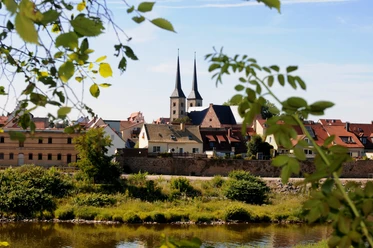
The damage caused by the devastating Mulde floods in 2002 and 2013 to the gymnasium and monastery church, in Paul-Gerhardt-Straße, and the entire old town was immense. To prevent such a disaster from happening again in Grimma, a flood protection system is being built along the Mulde riverbank. Let's look forward to being able to use the charming riverside path between the stone and suspension bridges again soon!
The District Museum nearby should definitely be noted for a visit. A large part of the books and artifacts were irretrievably lost in the Mulde floods. What has been carefully restored can now report all the more about Grimma's history... We follow the street named after the famous former Grimma state student Paul Gerhardt and the neat residential houses to Baderplan.
Baderplan 1
The current superintendent's office originated around the mid-13th century as the "Elisabeth Chapel", hospital, and seat of the Cistercian nuns before the construction of the Nimbschen monastery. The restored chapel is located on the ground floor and is also used for cultural purposes.
At the garden gate of the superintendent's office, we turn back and cross the street.
Fortunately, the bathhouse, which partially collapsed due to the Mulde floods, could be rebuilt – even if it no longer fulfills its original function.
Baderplan 12
The town bathhouse served in the Middle Ages for body hygiene, health, as well as casual cheerful sociability. It existed until the 16th century. A floor heating system from the 15th century and two black kitchens were identified.
We turn left towards the Großmühle with its yellow brick facade.
By the way, this is where the intact part of the city wall begins. One of the best-known wall houses belonged to Ludwig Ferdinand Stolle, who made a name for himself not only through the Grimma homeland song "In the valley where the Mulde flows..." but also as editor of the popular magazine "Die Gartenlaube".
The best view of the flood protection system and the city wall with its arcades is from the opposite riverside promenade below the city forest. We should take this walk on another day.
We go up Köhlerstraße, where a large corner house with the striking stepped gable attracts attention from afar.
Köhlerstraße 1
One of the oldest stone houses in Grimma with stepped gable and Gothic architectural elements was built in 1230 as a branch with a chapel of the Christian-secular Templar Order. Until 1529 it served as the city "Cross Hospital", then as a coach house and salt tavern.
We first leave the proud Frauenkirche on the right, cross Frauenstraße, and walk across Leipziger Platz, past the traditional hotel "Goldenes Schiff" and marvel at a reddish-brown angular portal diagonally opposite the hospitable place.
Leipziger Straße 5
The historically most valuable part of the city estate is the medieval residential tower (around 1230/40). Only in the 19th century was a complete farm with barn and stables set up here – right in the city. After the destructions caused by the flood in 2002, the ensemble was rebuilt in accordance with the monument.
Take the time to visit the photo documentation of the 2002 flood in the barn! The charming dollhouse exhibition (collection Lydia Hille) in the residential tower is by no means only interesting for children.
We now turn back towards the city center. The impressive twin towers of the Frauenkirche show us the way. First, however, we walk past the church on the right and pay attention to a rather inconspicuous building, which today again houses a leisure facility for children.
Frauenkirchhof 1
The so-called "Old Trade School" was built around 1530 as a "city boys' school." During the renovation of 1621, tombstones from the church surroundings were used. Both gables were adjoined by representative decorative blind arcades made of bricks.
If we're lucky now, we can finally take a look inside or enjoy a moment of peace in the old building: The Frauenkirche is the main church of the Evangelical Lutheran parish and a landmark of our city.
Frauenkirche
Around 1180, construction began on the double-towered west front of the omnipresent city church. This is followed by the Gothic basilica completed in 1239. Worth seeing are the late Gothic wing altar as well as Romanesque and Gothic capitals made of Rochlitz porphyry tuff.
Lange Straße is Grimma's main shopping street and connects Leipziger Platz and Market Square. It invites you to stroll and shop with numerous shops, cafés, and restaurants.
The attentive visitor will find many interesting architectural details such as seating niche portals, craft signs, bat dormers, and wooden Renaissance ceilings in some shops.
We slowly approach the market square and the end of our walk.
First, however, we turn into Kreuzstraße at the corner of Lange Straße 50.
The curious may gladly gather ideas for designing their own property in the charmingly designed, always hospitable courtyard!
Not only your appetite for good Saxon sausage should tempt you to take a detour to Kreuzstraße 12. A butcher's shop with such impressive glass ceiling paintings must simply be seen!
Take a look at the shoe shop Kreuzstraße 20 – because of the wooden ceiling! – then turn to the corner building opposite.
Nicolaistraße 2
The monumentally restored former farmer's estate with black kitchen and smithy dates back to the 13th century. The raising of the medieval city level by almost two meters is clearly visible inside by the uncovered paved floor.
Has the homeowner told you that here, as in many other houses in the city center, there was a hussar quarter until 1914? A club today revives their history.
We return to Lange Straße and head towards the market. The so-called "Department Store" also reminds us of a particularly dark chapter of German history. In Grimma alone, nearly 30 Jewish residents died between 1938 and 1943 after their deportation. Only a few were able to save their lives in exile.
Lange Straße 58
The first local "textile department store" over two floors was built in 1901 with lots of glass, steel, and cast-iron columns. The owner was until 1935 the Jewish businessman Motulsky, who died in Theresienstadt in 1942.
In 1949, it became the first state retail store (HO) on site.
Tour information
Cultural Interesting
Loop Road
Stop at an Inn
Suitable for Pushchair
Directions & Parking facilities
- Getting there
via the A14 Leipzig-Dresden, turn onto the B107 at the Grimma junction
ParkingVolkshausplatz (free of charge)
Prophetenberg/Colditzer Straße
Floßplatz
Public transportationTrain: Oberer Bahnhof Grimma Additional information
Literature
"Grimma - A Reader" ISBN: 3-930846-16-0
"I Praise My Grimma" 3 ISBN: 978-3-00-052911-5
"Grimma City Views" ISBN: 978-3-86729-142-2
Author
Nicole Mania
Organization
Stadt Grimma in der LEIPZIG REGION
Author´s Tip / Recommendation of the author
Every Saturday (May - October) at 11 a.m. there is a public city walk.
Cost per person: 5 euros, students: 2 euros.
Duration: approx. 60 minutes
Meeting point: Tourist Information Grimma, Markt 23 in 04668 Grimma
Further information is available at the Tourist Information Grimma at telephone number: 03437 9779011. No prior registration is necessary.
Nearby

Download GPX file