Hidden Leipzig: Waldstraßenviertel

Location
The Waldstraßenviertel Leipzig is located in the immediate vicinity of the city center. The Sportforum is also just a few minutes' walk away. The idyllic Rosental is also just a stone's throw away. More specifically, the district is bordered to the north by Leutzscher Allee, Zöllnerweg and Emil-Fuchs-Straße. In the south, it is bordered by Käthe-Kollwitz-Straße. The eastern edges are Pfaffendorfer Straße and Goerdelerring. In the west, the Waldstraßenviertel is bordered by Friedrich-Ebert-Straße.

Guided tours Waldstraßenviertel Leipzig
Don't want to discover the Waldstraßenviertel on your own? The Bürgerverein Waldstraßenviertel e.V. offers guided tours, usually every 1st and 3rd Saturday of the month. Guided tours are currently suspended due to the corona pandemic, but can take place on request. Provided the distance restrictions allow this. Hear stories about the houses, learn more about the architecture or follow in the Jewish footsteps in the district. Other tours will take you back to the Wilhelminian era, explain the city's water concept or let you experience Leipzig from its sporty side. The meeting point is always at 2 pm at the association's citizens' office. The 1.5 to 2-hour tours cost 8 euros per person. Guided tours will take place regularly again from June onwards.

Architecture
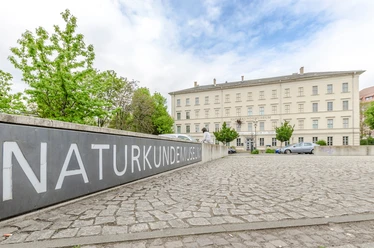
On a walk through the Waldstraßenviertel, you have to be careful not to be taken aback by all the beautiful architecture. In a relatively small area, you will experience a time travel through Leipzig's housing history from 1830 to the present day. Between the Natural History Museum and the Mückenschlösschen there are simple residential buildings from before 1840. There are also magnificent suburban houses from the period between 1840 and 1870 as well as Wilhelminian-style tenement houses and villas from the period up to 1900. Last but not least, there are also residential buildings from Art Nouveau architecture from around 1900 as well as buildings from 1920 to 1940. Finally, there are also buildings from residential architecture after 1900. In the yard of Jahnallee 6 you will find the oldest surviving residential building. The oldest structure of the farm building of the former Ratsziegelei dates from 1740. Even the builder of the Monument to the Battle of the Nations, Clemens Thieme, has left his mark on the Waldstraßenviertel. He owned a magnificent residential building at Tschaikowskistraße 4.

Our recommendations
Waldstraßenviertel Leipzig: History
In the area of today's Waldstraßenviertel, there were initially Slavic settlements. The Elster-Pleiße floodplain provided the inhabitants with the water they needed to survive. Due to the extensive river regulation work in the 10th to 12th centuries, the relocation of the Parthe and the construction of the Elster millrace, new settlements were quickly added. However, the settlements did not belong to Leipzig, but were located outside the city gates. This changed in the 15th century. As the population grew, the city of Leipzig could no longer feed itself. It therefore bought up the settlements outside its gates, including the large production potential. The boom in Leipzig was unstoppable.
From 1830, the city began to develop into a metropolis. New living space was needed. The hope of using the area of today's Waldstraßenviertel as building land was destroyed by the recurring spring floods. It was not until the construction of the Elster-Saale Canal in the 1960s that the Waldstraßenviertel could be developed. Leipzig not only developed into a business and trade metropolis, but also a cultural and intellectual center. For this reason, Leipzig became increasingly attractive for Jewish traders and business people. The Jews, most of whom came from Eastern Europe, found a new home above all in the new and modern Waldstraßen district. Jewish culture and Jewish life were visible to everyone in everyday life in the district. The district was soon popularly known as New Jerusalem.

Do you still have questions about the Waldstraßenviertel Leipzig? Then get in touch with us!
Leipzig Tourismus und Marketing GmbH
Augustusplatz 9
04109 Leipzig
Tel. +49 (0)341 7104-260
www.leipzig.travel
social.media@ltm-leipzig.de