St. George's Church Rötha


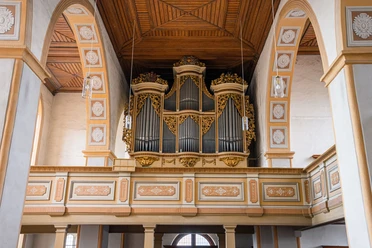
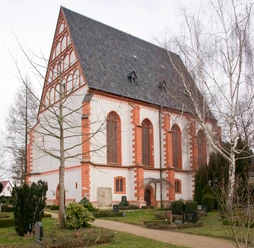
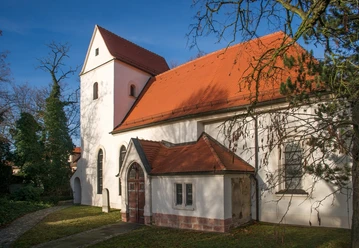
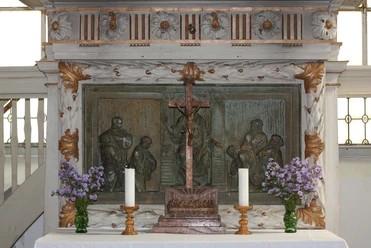
The double tower in the west dates back to the 12th century and the adjoining three-aisled late Gothic hall church was built around 1500. The wooden flat ceiling was installed in 1896. An early baroque altar, the pulpit from around 1600 and an octagonal porphyry font from the end of the 15th century characterize the furnishings of the choir room. The famous Gottfried Silbermann organ from 1721 is located in the west gallery.
Gottfried Silbermann (1683 - 1753) learned organ building from his brother Andreas (1678 - 1734) in Strasbourg before running his own company in Freiberg from 1711. In December 1718, the church patron Baron von Friesen concluded a contract with Gottfried Silbermann and Zacharias Hildebrandt to build a new organ. II/23 On November 8, 1721, the organ was inspected by Thomaskantor Johann Kuhnau from Leipzig and court organist Gottfried Ernst Bestel from Altenburg. Felix Mendelssohn Bartholdy praised the two Silbermann organs after his visit to Rötha in 1840. In 1796 the university organ builder Stephani installed a switchable pedal coupler. The last major restoration was carried out in 1979 - 80 by the Eule company.
Text: Klaus Gernhardt
Good to know
Directions & Parking facilities
- By car: Follow the B2 and B95 to Rötha, take the B95 exit in the direction of A38/Leipzig/Rötha/Zentraldeponie. Take Lessingstraße and August-Bebel-Straße to Johann-Sebastian-Bach-Platz.
By public transport: Take the S5, S5x or S6 to Böhlen (Leipzig), then take bus 144, 146 or 272 to Rötha, Markt. Social Media
Organization
Leipzig Tourismus und Marketing GmbH
License (master data)
Leipzig Tourismus und Marketing GmbH