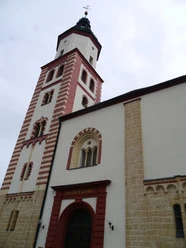
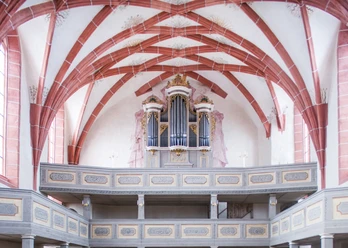
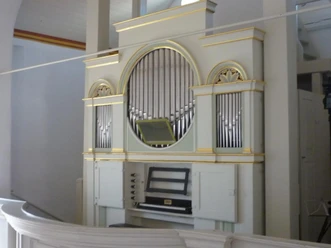
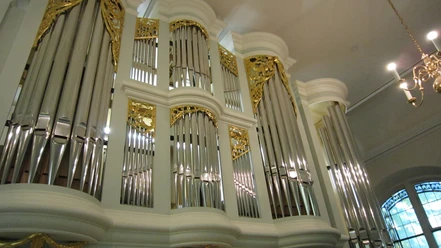
Silbermann organ in the St. Georgenkirche Rötha
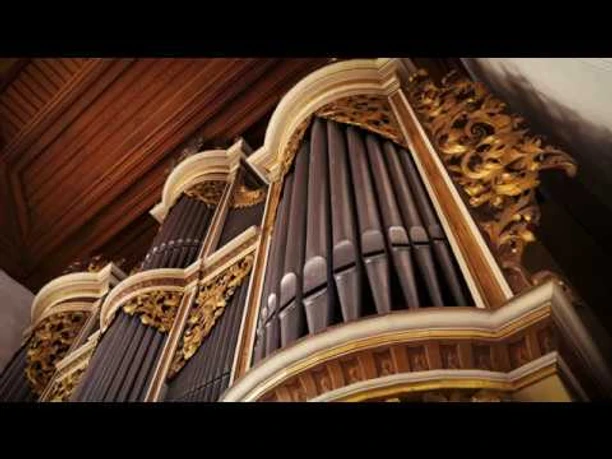


Today, the Silbermann organ in St. George's Church, like the Silbermann organ in St. Mary's Church in Rötha, which was built three years later, is one of the cultural beacons in Leipzig's Neuseenland region. Organ tourists and organists from all over the world are welcome guests in both churches. The European Organ Academy and the Bach Competition in Organ regularly take place in Rötha.
Disposition
Main organ (C, D-c''')
1 Bordun 16'
2 Principal 8'
3 Rohr Flöte 8'
4 Octava 4'
5 Spitz Flöte 4'
6 Quinta 3'
7 Octava 2'
8 Cornet 3 fach ab c'
9 Mixtur 3 fach
10 Cymbeln 2 fach
Oberwerk (C, D-c''')
11 Gedackt 8'
12 Quintadena 8'
13 Principal 4'
14 Rohr Flöte 4'
15 Nasat 3'
16 Octava 2'
17 Tertia 1 3/5'
18 Quinta 1 1/2'
19 Sifflet 1'
20 Mixtur 3 fach
Pedal (C, D-c')
21 Principal Bass 16'
22 Trombone 16'
23 Trommete 8'
Manual sliding coupler
Pedal coupler (I/P), switchable since 1796
Tremulant
Pitch
Chorton, currently 464.9 Hz/a¹
Tuning
Equal temperament since 1832
The spelling corresponds to the tradition.Good to know
Eligibility
Suitable for any weather
for Groups
for individual guests
Suitable for the Elderly
Foreign Language
- German
Directions & Parking facilities
- By public transport: From Leipzig main station, take the S-Bahn line S5X or S6 to Böhlen S-Bahn station and then the bus line 144 or 101 to Rötha, Markt (approx. 2 minutes on foot).
By car: Follow the B2 and A72 to the Böhlen or Rotha exit. Social Media
Organization
Leipzig Tourismus und Marketing GmbH
License (master data)
Leipzig Tourismus und Marketing GmbH