In the glow of Leipzig's neon signs - the pianist Clemens Christian Poetzsch

Five questions for Clemens Christian Poetzsch
Your Leipzig and good coffee?
"Café 7 Shots is one of my favorites. I also love going to Milchbar Pinguin. Not least because of the beautiful neon sign on the façade."
Your Leipzig and bike?
"I prefer to go for a walk. Sometimes I walk around aimlessly, for example in the direction of Eisenbahnstraße. Or here in the city center. Then I'm happy when I get lost and end up somewhere I've never been before."
Your Leipzig and culture?
"I love the Horns Erben. I've often played concerts there. Great operator, cozy place, downstairs you can eat, drink and chill, upstairs you have this little cinema with a nice stage. And a really great grand piano, by the way. It's my favorite cultural venue."
Your Leipzig and architecture?
"Yesterday I walked past the Ring Café again - on the one hand, it looks totally brutal and oversized - on the other hand, there's something poetic about its curved shape and the fact that there are so many people inside."
And your favorite music?
"I'm currently discovering the albums of songwriter Julia Holter for myself. Crazy, intense, multi-faceted music - really incredible."
Building something from nothing
Like every boy, Clemens just wanted to play soccer and hang out as a small child. He comes from a family of musicians and his father always told Clemens to just get on with piano. "I would have stopped back then. My piano lessons were on Fridays with a strict Russian teacher - the technique always had to be right, the hand position had to be perfect. That was always exhausting for me as a small child. Today I am grateful to them for that." And one day, Clemens received a gift from his dad - a book of jazz standards.
At some point, he asked in a small restaurant around the corner if he could play the piano there. "I ended up playing bar music there every Sunday for 25 marks when I was 10 years old. That was great fun. I always had my thick music books with me, as I could only play from sheet music at first and couldn't improvise." The piano stood by the revolving door from which the waiters always came out with the food. The notes kept falling down due to the wind, so he always had to pick them up again and start from the beginning. "That was really embarrassing," he laughs, "at some point I started to leave the notes lying around and make something up." It was at this point that Clemens discovered how much he likes improvising and that people respond to his music. "At some point, I thought that I want to do this all my life, because I can build my own world that way."

Clemens-Christian-Poetzsch plays his grand piano at a concert

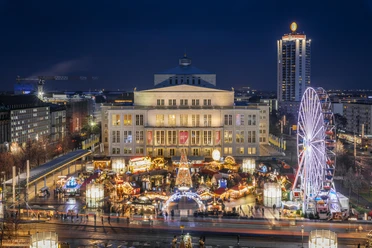
Neon Leipzig
One evening, Clemens walks through the southern suburbs at night on his way home. He hadn't lived here long and breathed in the Leipzig atmosphere every day as he walked. He stopped briefly at the Feinkost, now a cultural hotspot in Leipzig, where beer was brewed and canned food was produced and stored. Day and night, a colorful neon light shines on the façade - the Löffelfamilie. Clemens liked looking at the beautiful neon sign. He liked it. Shortly afterwards, he created Neon Leipzig, part of his album "Remember Tomorrow". "In Leipzig, you can see the neon neon signs from the past on some corners of the city. That gives me a good feeling. It has something of the past and the present, it lights up, it looks old but new at the same time. When I think of Leipzig, my first associations are these old neon signs."
Clemens is now a professional composer. When he started composing, he used to walk around with an old dictation machine with a large cassette in it. He bought a lot of these cassettes and played them at home because he couldn't really translate them into sheet music back then. When he eventually had too many, he started thinking about how to actually write down the compositions. "The moment of inspiration is sometimes very sacred. You can't reproduce it exactly if you only have that moment on a cassette. You need some kind of written record of it." Bit by bit, Clemens learned how to write down the notes correctly when composing. This was followed by his first real band and his specialist studies.
And what was it like with Neon Leipzig? "It gave me a certain feeling. Not a concrete idea that you want to put into practice, but a feeling that you can't describe. But which you want to preserve in music. Sometimes that's enough." He remembers the neon sign at the delicatessen: "It was just a place where I really enjoyed being and I wanted to transform that into music. I tried different things for a long time until I found the feeling in the music that I had felt in that exact place."
<p
An owl sits on the shoulder of Clemens Christian Poetzsch

From the cassette to Rammstein and film music
Meanwhile, Clemens plays with orchestras, has released several solo albums, rearranged the music of Rammstein, and also composed the music for the successful Czech filmNational Road. "It's always been my dream to compose film music directly or to have my own music used for a movie." But of course it's incredibly difficult to get into the scene. "You can't apply for something like this and send a letter of application. It has to come to you."
Contacts were made, including with producers. Then Clemens and guitarist Reentko Dirks were asked if they wanted to do the film music for "National Road". They met the director Štěpán Altrichter, who also thought their idea was great. They read the book by Jaroslav Rudiš, got the script and then had a lot of freedom to decide how the music would sound. "It was inspired work. It was great fun." The music has been very well received by critics, especially in Germany. "Good first film", laughs Clemens.
Clemens has another relationship with the Czech Republic: in 2019, he traveled through several Czech cities as part of his "East Europe Tour" and played his music. This year, he also managed to give an open-air concert in Prague's cultural hotspot "Stalin". He also always enjoys the train journey between Saxony and the Czech Republic - not least because of the Czech delicacies in the on-board restaurant.

You can see the back view of Clemens sitting in front of a grand piano, Musikstadt Leipzig, grand piano

Leipzig - the perfect city to live in
And what does Clemens think of Leipzig as a place to live? - "A very relaxed place to arrive. Because I also travel a lot for concerts, it's very important for me to have a place where I feel really comfortable. And where I have the feeling that the music scene is interwoven, that the focus is on the future. Because it's international, the feeling here is much faster. New things are constantly being created here - whether it's a new café or a musical project. It's a good feeling to live in a place like this, a place that moves but still gives you peace and quiet and doesn't overwhelm you."
Dive into Clemens' music, which is as free as the city that inspires him, contemplative but also refreshing like Leipzig's bright neon signs. Ideally at home with a good record player or next year in April at a concert at Horns Erben.
.