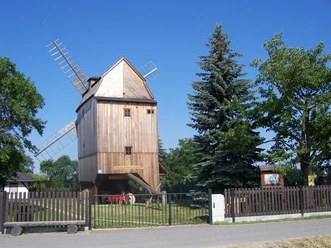
This technical monument will delight insiders. The trestle windmill, which has been a technical monument since 1991, is located at Radegaster Weg 7, a few hundred meters after the village exit sign. It is called a trestle windmill because its foundation consists of a trestle. The trunnion extends from this as a fixed element to the grinding beam, which is the supporting element of the upper part of the mill. The mill rotated on the grinding beam until its restoration, which took place before and after the fall of the Berlin Wall.
Herbert Weber owned the mill from 1973 to 1987. Nowadays, he gives guided tours of the technical monument. According to him, the mill was built between 1838 and 1841. It was mainly built in the summer months, as the winters used to be harsher. The mill and millyard are located on a small hill and cover an area of 600 m². The builder, a miller and farmer named Ebert, sold the mill to Robert Willig in 1895. He was the grandfather of Mrs. Weber, née Willig. Alfred Willig, his son and father of Mrs. Elfriede, took over the mill in 1925. In 1927, the mill was converted to electric drive. In that year, the overhead power line was laid from Luppa to Radegast. It made sense to provide the mill with electricity in this context. Until then, wind had been the only source of power.
When there was little wind, the miller had to work into the night. However, wind was still used together with electricity to drive the mill blades, as this allowed electrical energy to be used sparingly. The electric motor had 10 HP. With the electrification, a roller mill and a separating machine were purchased. It was now possible to produce rye flour; with wind propulsion, only grist could be produced. In ten hours of work, the miller produced ten hundredweight of flour, which was his daily output. These ten hundredweights explain why the windmill was considered a 0.5-ton mill. The 10 hundredweights of flour were ground from 15 hundredweights of grain. This was a grinding rate of just under 70 % and is still average today. The technological specification meant that the grains had to pass over the wheat mill and sifter six times. Flour was constantly falling off. The gross quantity of grains became less and less, and the quantity of flour increased. After each pass, the rollers were narrowed. The flour was white at first and became darker towards the end. After grinding, they were mixed in a machine so that a color came out. In 1951, Herbert Weber made his appearance. He took care of the farming and helped in the mill when needed. This was easy for him because he was a trained miller. When the agricultural production cooperatives (LPG) came into being in 1960, flour was no longer milled, but only ground. All types of grain were processed. Flour production was the responsibility of the large flour mills. After 1973, the LPG type I (collective cultivation of fields, but private livestock farming) was converted into LPG type III (collective cultivation of fields and livestock farming). As a result, there was no more grain to grind and the history of the mill's production came to an end. The Webers sold their mill to the municipality of Luppa in 1987, after 92 years of family ownership.
The municipality had the mill restored with subsidies and turned it into a technical monument, a museum. This took place between July 1989 and May 1991, but now it can no longer be turned and its wings have been secured for safety reasons.
Today, the Luppa local history association is responsible for maintaining the mill and also offers guided tours.