Museums at GRASSI


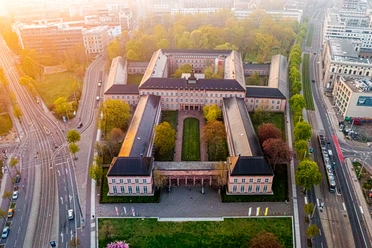
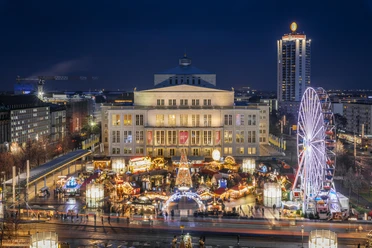
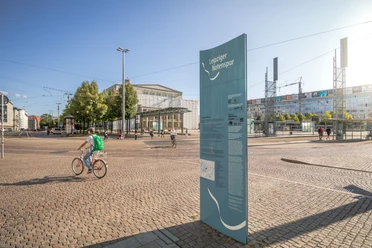
Built between 1925 and 1929, the building complex now houses three museums under one roof and also serves as a venue for exhibitions, events, and gatherings. It is named after the Leipzig merchant and patron Franz Dominic Grassi.
It was designed by the architects Zweck and Voigt under the overall supervision of Leipzig’s city planning officer, Hubert Ritter. With its striking design, the building is exemplary of the architecture of the Weimar Republic: stylistically, it combines elements of Art Deco and New Objectivity. It is one of the few significant new German museum buildings from this period.
Particularly striking are the building’s grand interior spaces and artistic furnishings. These include the Pfeilerhalle, an impressive Art Deco-style event hall, as well as the 18 stained-glass windows by Josef Albers in the main stairwell. Originally designed in 1927 and standing up to seven meters tall, the windows were destroyed during World War II and later reconstructed true to the original based on historical visual sources. They are considered one of the most significant glass designs of the Dessau Bauhaus period.
The inner courtyards are also an essential part of the complex. The tower stairwells in the inner courtyard underwent extensive renovation in 2021 and 2022, during which the characteristic Art Deco-style facades and window grilles were preserved. Together with the adjacent park-like Old St. John’s Cemetery, the GRASSI forms a unique cultural site that combines architecture, history, and recreation.
It was designed by the architects Zweck and Voigt under the overall supervision of Leipzig’s city planning officer, Hubert Ritter. With its striking design, the building is exemplary of the architecture of the Weimar Republic: stylistically, it combines elements of Art Deco and New Objectivity. It is one of the few significant new German museum buildings from this period.
Particularly striking are the building’s grand interior spaces and artistic furnishings. These include the Pfeilerhalle, an impressive Art Deco-style event hall, as well as the 18 stained-glass windows by Josef Albers in the main stairwell. Originally designed in 1927 and standing up to seven meters tall, the windows were destroyed during World War II and later reconstructed true to the original based on historical visual sources. They are considered one of the most significant glass designs of the Dessau Bauhaus period.
The inner courtyards are also an essential part of the complex. The tower stairwells in the inner courtyard underwent extensive renovation in 2021 and 2022, during which the characteristic Art Deco-style facades and window grilles were preserved. Together with the adjacent park-like Old St. John’s Cemetery, the GRASSI forms a unique cultural site that combines architecture, history, and recreation.
Good to know
Openings
- All three museums will be closed on December 24 and 31.Dayoff: Monday
Price info
- The current admission prices can be found on the museums' websites.
Eligibility
Suitable for any weather
for Groups
for Class
for individual guests
Suitable for the Elderly
Directions & Parking facilities
- By public transportation: The nearest stop is Leipzig, Johannisplatz (tram lines 4, 7, 12, 15). Other stops in the immediate vicinity: Augustusplatz, Leipzig Markt, Leipzig Hauptbahnhof.
By car: Use the surrounding downtown parking garages, such as the Gutenberg-Galerie parking garage, Q-Park Augustusplatz, and Q-Park The Post. Parking spaces are also available on Täubchenweg as well as on Inselstraße, Dresdner Straße, Talstraße, and Salomonstraße. Organization
Leipzig Tourismus und Marketing GmbH
License (master data)
Leipzig Tourismus und Marketing GmbH