Pork Mendelssohn organ in the Church of the Resurrection in Möckern


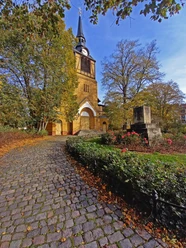
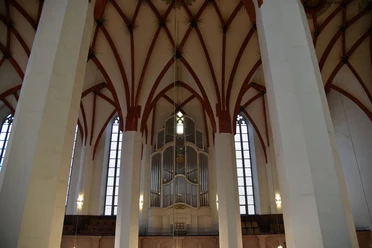
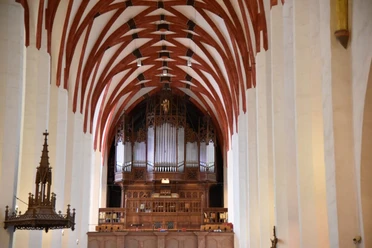
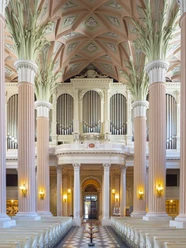
The fact that this organ has been played every Sunday during church services since 1767 is due to a series of fortunate circumstances. It was originally built between 1766 and 1767 by the Leipzig university organ builder Johann Christian Immanuel Schweinefleisch (1721-1771) for the then church hall of the Reformed congregation, which was located in the so-called Amtshaus on Thomaskirchhof.
This congregation consisted of the families of Huguenots who had fled to Leipzig from France around 1700 and were persecuted for their Protestant faith. Although some of them were wealthy cloth merchants, they were not granted citizenship in Leipzig and the holding of their Reformed church services was viewed with suspicion. The Lutheran citizens even tried to prevent the construction of this organ by petitioning the Dresden court. However, the Catholic king instead expressed his protection for the confessional minority.
The student Johann Wolfgang Goethe was present at the rededication of the renovated church hall with the new organ, describing it as "excellent". Acceptance took place on July 16, 1767 by Thomaskantor Johann Friedrich Doles (1715-1797). The first organist was the later Dresden Kreuzkantor Christian Ehregott Weinlig (1743-1813). For many years, the organ was the most modern instrument of its kind in Leipzig.
None other than the reformed parishioner Felix Mendelssohn-Bartholdy was in discussion for an examination of the organ when it was overhauled by university organ builder Johann Gottlob Mende in 1841.
An extension to three manuals was carried out between 1870 and 1873 by Carl Bernecker.
After the new reformed church on Tröndlinring was consecrated in 1899, the instrument was offered for sale and ended up in the newly built Auferstehungskirche in Möckern in 1901. This was actually only intended as a transitional church for the ever-growing congregation, which is why they were satisfied with a second-hand instrument. The conversion was carried out by Gottfried Hildebrand.
An initial restoration with a return to two manuals was carried out in 1983 by Hartmut Schüßler (Greiz). The current condition dates back to the thorough restoration carried out by Ekkehart Groß (Waditz) in 2004. The organ was restored to the condition it was in in 1841, the time of Felix Mendelssohn. The Möcken Organ Festival has been held annually since 2004.
Disposition
I. Manual
Bordun 16'
Principal 8'
Rohrflöte 8'
Viola di Gamba 8'
Octave 4'
Gemshorn 4'
Quinte 22/3'
Octave 2'
Mixtur 4-5fach
Cornett 3fach ab c0
Trompete 8'
II. Manual
Gedackt 8'
Quintatön 8'
Salicional 8'
Principal 4'
Rohrflöte 4'
Nasat 22/3'
Waldflöte 2'
Mixtur Triple
Oboe 8'
Pedal
Principal bass 16'
Subbass 16'
Trombone bass 16'
Octave bass 8'
Cello 8'
This congregation consisted of the families of Huguenots who had fled to Leipzig from France around 1700 and were persecuted for their Protestant faith. Although some of them were wealthy cloth merchants, they were not granted citizenship in Leipzig and the holding of their Reformed church services was viewed with suspicion. The Lutheran citizens even tried to prevent the construction of this organ by petitioning the Dresden court. However, the Catholic king instead expressed his protection for the confessional minority.
The student Johann Wolfgang Goethe was present at the rededication of the renovated church hall with the new organ, describing it as "excellent". Acceptance took place on July 16, 1767 by Thomaskantor Johann Friedrich Doles (1715-1797). The first organist was the later Dresden Kreuzkantor Christian Ehregott Weinlig (1743-1813). For many years, the organ was the most modern instrument of its kind in Leipzig.
None other than the reformed parishioner Felix Mendelssohn-Bartholdy was in discussion for an examination of the organ when it was overhauled by university organ builder Johann Gottlob Mende in 1841.
An extension to three manuals was carried out between 1870 and 1873 by Carl Bernecker.
After the new reformed church on Tröndlinring was consecrated in 1899, the instrument was offered for sale and ended up in the newly built Auferstehungskirche in Möckern in 1901. This was actually only intended as a transitional church for the ever-growing congregation, which is why they were satisfied with a second-hand instrument. The conversion was carried out by Gottfried Hildebrand.
An initial restoration with a return to two manuals was carried out in 1983 by Hartmut Schüßler (Greiz). The current condition dates back to the thorough restoration carried out by Ekkehart Groß (Waditz) in 2004. The organ was restored to the condition it was in in 1841, the time of Felix Mendelssohn. The Möcken Organ Festival has been held annually since 2004.
Disposition
I. Manual
Bordun 16'
Principal 8'
Rohrflöte 8'
Viola di Gamba 8'
Octave 4'
Gemshorn 4'
Quinte 22/3'
Octave 2'
Mixtur 4-5fach
Cornett 3fach ab c0
Trompete 8'
II. Manual
Gedackt 8'
Quintatön 8'
Salicional 8'
Principal 4'
Rohrflöte 4'
Nasat 22/3'
Waldflöte 2'
Mixtur Triple
Oboe 8'
Pedal
Principal bass 16'
Subbass 16'
Trombone bass 16'
Octave bass 8'
Cello 8'
Good to know
Author
Leipzig Tourismus und Marketing GmbH
Grimmaischen Steinweg 804103 LeipzigOrganization
Leipzig Tourismus und Marketing GmbH