Bach organ in the Thomaskirche Leipzig


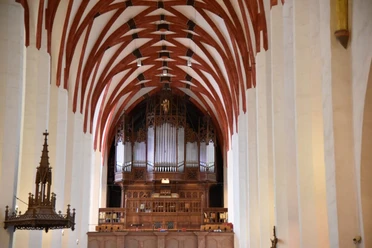
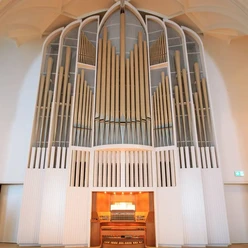
It was created on the initiative of St. Thomas organist Ullrich Böhme and was built by the Gerald Woehl organ workshop. The organ is located in the north gallery opposite the Bach window.
Its case is reminiscent of the baroque organ in the University Church of St. Pauli, which was destroyed in 1968. Johann Sebastian Bach had played and inspected this baroque organ in 1717. Woehl adapted the case to the spatial conditions in St. Thomas Church and to the four-manual specification of the new instrument, which is crowned by an additional Oberwerk.
The organ has 61 stops on four manuals (Hauptwerk, Oberwerk, Brustwerk and Echo) and Pedal and is based on a historical specification from Bach's time. This was designed in 1698 by Johann Christoph Bach, Johann Sebastian Bach's uncle, for the Georgenkirche in Eisenach. Johann Sebastian Bach experienced the construction of this instrument as a child and was evidently deeply influenced by it, as he repeatedly demanded similar timbres in later reports. However, the original Eisenach instrument no longer exists today.
The sound of the Bach organ is also based on 18th century Central German organ building: both the construction of the pipes and their voicing make it particularly suitable for performing the organ works of Johann Sebastian Bach.
Disposition
I Brustwerk C-f3
Grob Gedackt 8′
Klein Gedackt 4′
Principal 2′
Super Gemßhörnlein 2′
Quint-Sexta II
Sieflit 1
II Hauptwerk C-f3
Bordun 16′
Principal 8′
Violdigamba 8′
Rohrflöth 8′
Quinta 6′
Octave 4′
Nassatquint 3′
Superoctave 2′
Queerflöth 2′
Sesquialtera III
Mixture VI
Cimbel III
Bassoon 16′
Trombetta 8′
III Oberwerk C-f3
Quintades 16′
Principal 8′
Gemßhornb8′
Gedackt 8′
Flauta doux 8′
Octav 4′
Hohlflöth 4′
Hohlquint 3′
Superoctav 2′
Plockflöth 2′
Sesquialtera III
Scharff IV
Hautbois 8′
Vox Humana 8′
Tremulant
IV Echo C-f3
Barem 16′
Still Gedackt 8′
Quintades 8′
Principal 4′
Nachthorn 4′
Spitzflöth 4′
Spitzquint 3′
Octav 2′
Schweitzerflöth 2′
Rauschquint 1 1⁄2′
Superoctävlein 1′
Cimbel III
Shelf 8′
Pedal C-f1
Basement 32′
Principal 16′
Violon 16′
Sub Bass 16′
Octave 8′
Quintaves 8′
Gedackt 8′
Superoctave 4′
Bauerflöth II 1′
Mixture VI
Posaun Bass 32′
Posaun Bass 16′
Trombet 8'
Cornet 2′
Playing aids
Side stops
Tremulant for the whole work
Cymbal star for the plenum
Cymbal star for small registrations
Glockenspiel (c°-c'''), playable from the Oberwerk
Vogel Geschrey
Plenum Wind (additional bellows)
Koppeln
Oberwerk/Hauptwerk (III-II)
Echo/Hauptwerk (IV-II)
Main action/Pedal (II-P)
Upper action/Pedal (III-P)
Chamber tone coupler for the whole organ (466/415 Hz)
Sound ranges Choir tone 466 Hz: Manuals C-f''', Pedal C-f'
Sound scales concert pitch 415 Hz: Manuals C, D-f''', Pedal C, D-f'
Inequal temperament according to Neidhardt (modified)
a' = 466 Hz at approx. 21° Celsius
Wedge bellows system with 4 large bellows under the gallery floor, separated into pedal and manual winds, fed by two centrifugal blowers and prebellows.
Good to know
Author
Leipzig Tourismus und Marketing GmbH
Grimmaischen Steinweg 804103 LeipzigOrganization
Leipzig Tourismus und Marketing GmbH