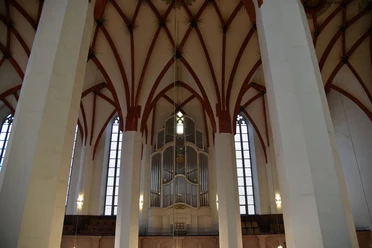
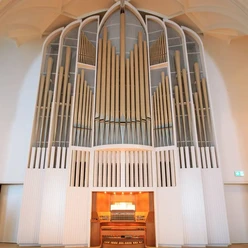
Sauer organ in the Thomaskirche Leipzig


It had 63 stops on three manuals and pedal as well as mechanical cone chests. The first tonal and technical changes were made just 13 years later. After Karl Straube took office as organist at St. Thomas in 1902, plans were made to expand the instrument, which Wilhelm Sauer implemented in 1908: the organ was expanded to its current size of 88 stops with pneumatic action and stop action.
Over time, the sound of the instrument was changed in the neo-baroque style before it was restored to its 1908 condition in several stages by the Christian Scheffler workshop from 1988 onwards. Due to its size, quality and historical significance, the organ is one of the most important late-romantic instruments in Germany and has international monument status.
During the church renovation from 1997 to 2000, it was the only playable instrument and was heavily contaminated by building dust. For this reason, the entire pipework with around 6,000 pipes was removed, cleaned, overhauled and retuned in 2005. At the same time, the vault above the organ had to be renovated due to cracks. Thanks to extensive donations, in particular from the Thomaskirche-Bach e.V. association, four missing pedal stops could also be reconstructed true to the original. The Sauer organ was finally rededicated in October 2005.
Disposition
I Hauptwerk C-a3
Principal 16′
Bordun 16′
Principal 8′
Double Flute 8′
Violin Principal 8′
Gamba 8′
Flute 8′
Quintatone 8′
Gemshorn 8′
Flauto dolce 8′
Gedackt 8′
Dulciana 8′
Quinte 5 1⁄3′
Octave 4′
Violini 4′
Gemshorn 4′
Rohrfloete 4′
Octave 2′
Rauschquinte II
Mixture III
Cornet II-IV
Sharp V
Large Cymbel IV
Bombard 16′
Trumpet 8′
II Manual C-a3
Salicional 16′
Gedackt 16′
Principal 8′
Schalmei 8′
Flûte harmonique 8′
Concertfloete 8′
Harmonica 8′
Rohrfloete 8′
Salicional 8′
Gedackt 8′
Dolce 8′
Octave 4′
Salicional 4′
Flauto dolce 4′
Quinte 2 2⁄3′
Piccolo 2′
Cornett III
Mixture IV
Cymbel III
Tuba 8′
Clarinett 8′
III Swell C-a3
Gamba 16′
Gedackt 16′
Principal 8′
Viola 8′
Spitzfloete 8′
Quintatön 8′
Flûte d'Amour 8′
Gemshorn 8′
Gedackt 8′
Aeoline 8′
Voix céleste 8′
Praestant 4′
Transverse flute 4′
Fugara 4′
Traversfloete 4'
Quinte 2 2⁄3′
Flautino 2′
Harmonia aetheria III
Trompette harmonique 8′
Oboe 8′
Pedal C-f1
Major Bass 32′
Subbass 32′
Contrabass 16′
Principal 16′
Violon 16′
Gemshorn 16′
Subbass 16′
Salicetbass 16′
Lieblich Gedackt 16′
Quintbass 10 2⁄3′
Open bass 8′
Octave 8′
Cello 8′
Gemshorn 8′
Bass flute 8′
Dulciana 8′
Octave 4′
Flauto dolce 4′
Trombone 32′
Trombone 16′
Bassoon 16'
Trumpet 8′
Clarine 4′
Playing aids
- Manual couplers II/I, III/I, III/II
- Pedal couplers I/P, II/P, III/P
Couplers can be switched individually in the manual stops and free
combinations as well as permanently acting as pushbuttons/pedal steps
- Tutti coupler (as step)
- Pedaloctave coupler (as step)
- Manual suboctave coupler (as pushbutton, = II/I sub)
- Fixed combinations: Mezzoforte, Tutti
- Piano, Mezzoforte, Forte and Tutti pedals
- Pedal voices off, manual stops off, Reed stops on and off
- Three freely adjustable combinations
- Roller swell (roll) with stop (couplers not integrated in roll)
- Blind swell for manual III
- Tubular pneumatics (action and stop action)
- Range (a' = 443 Hz at approx. 21° Celsius): Manuals C-a''', Pedal C-f'
- Equal temperament
Good to know
Author
Leipzig Tourismus und Marketing GmbH
Grimmaischen Steinweg 804103 LeipzigOrganization
Leipzig Tourismus und Marketing GmbH
License (master data)
Leipzig Tourismus und Marketing GmbH