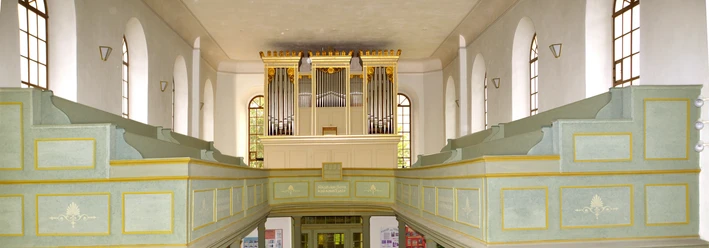
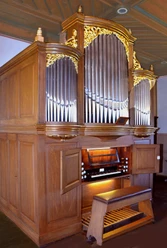
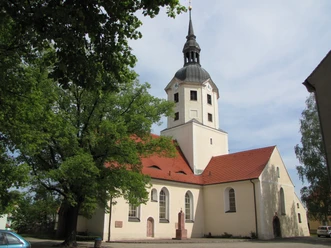
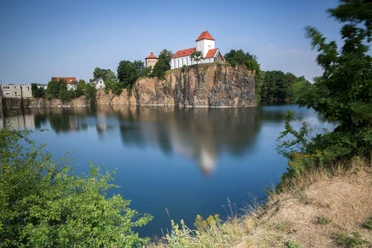
Schmeisser organ in the Bergkirche Beucha

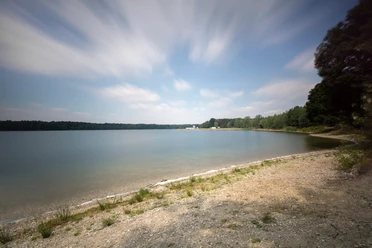
Surrounded on three sides by the water of the former quarry, the rock pulpit behind the church is also a charming viewpoint of the flat Leipzig countryside.
The origins of the organ go back a long way: Johann Gottlieb Trampeli repaired the existing pedal-less instrument between 1790 and 1792 and extended it. In 1847, the organ was overhauled again by Wilhelm Hellermann. Around 70 years later, however, it was in a very poor condition, so Alfred Schmeisser (1902-1945) from Rochlitz installed the 1863 Kreutzbach organ from the Martin Luther Church in Markkleeberg in the existing Hellermann case in 1931. Damaged by bombs, the organ was removed again in 1945. Almost ten years later (1954), Schmeisser reinstalled the organ with a modified specification - the organ is still played today with this specification of 17 stops (8-6-3). And this after it had to be removed once again in the meantime and could not be played for 17 years.
Disposition:
1. Manual (C-e''') Hauptwerk
Pommer 16'
Principal 8'
Gemshorn 8'
Octave 4'
Flöte 4'
Octave 2'
Cornett 3fach, ab c'
Mixtur 1 1/3' 3fach
2. Manual (C-e''') Hinterwerk:
Gedackt 8'
Principal 4'
Rohrflöte 4'
Nasat 2 2/3'
Waldflöte 2'
Terz 1 3/5'
Pedal (C-d')
Subbass 16'
Principal bass 8'
Cello 8'
Playing aids/auxiliary slides
Manual coupler
Pedal coupler I
Pedal coupler II
Source: Kirchgemeinde Brandis-Beucha, Wikipedia.org
The origins of the organ go back a long way: Johann Gottlieb Trampeli repaired the existing pedal-less instrument between 1790 and 1792 and extended it. In 1847, the organ was overhauled again by Wilhelm Hellermann. Around 70 years later, however, it was in a very poor condition, so Alfred Schmeisser (1902-1945) from Rochlitz installed the 1863 Kreutzbach organ from the Martin Luther Church in Markkleeberg in the existing Hellermann case in 1931. Damaged by bombs, the organ was removed again in 1945. Almost ten years later (1954), Schmeisser reinstalled the organ with a modified specification - the organ is still played today with this specification of 17 stops (8-6-3). And this after it had to be removed once again in the meantime and could not be played for 17 years.
Disposition:
1. Manual (C-e''') Hauptwerk
Pommer 16'
Principal 8'
Gemshorn 8'
Octave 4'
Flöte 4'
Octave 2'
Cornett 3fach, ab c'
Mixtur 1 1/3' 3fach
2. Manual (C-e''') Hinterwerk:
Gedackt 8'
Principal 4'
Rohrflöte 4'
Nasat 2 2/3'
Waldflöte 2'
Terz 1 3/5'
Pedal (C-d')
Subbass 16'
Principal bass 8'
Cello 8'
Playing aids/auxiliary slides
Manual coupler
Pedal coupler I
Pedal coupler II
Source: Kirchgemeinde Brandis-Beucha, Wikipedia.org
Good to know
Openings
Contact person
Kirchgemeinde Beucha-Albrechtshain
Organization
Leipzig Tourismus und Marketing GmbH