St. Marien zu Schildau

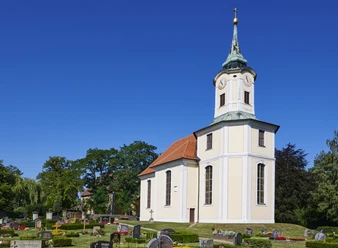
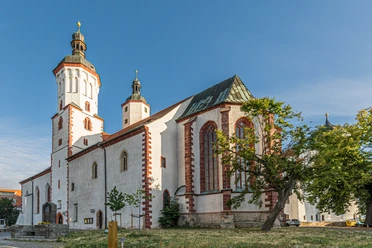
When the late Romanesque basilica was built around 1170, it was simply added to an existing tower, which, with walls 1.60 meters thick and an entrance that could only be reached with a ladder, probably served defensive and refuge purposes.
The wide Romanesque arch visible inside the church in the east wall of the tower dates from the time when the church was added in the form of a three-aisled basilica.
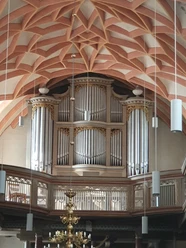
Conversions in the 15th century gave the interior its current appearance. The columns were removed, the clerestory windows were walled up and a ribbed vault was installed. One of the clerestory windows - located above the ribbed vault - has since been uncovered for viewing. It still has the wooden frame for fastening the parchment skin, which had to serve as "window glass" at the time. Incidentally, an old pillar remains - the Renaissance baptismal font stands on it in the choir square. The sacristy in the north wall of the choir square also dates from the 15th century. Here, fitted into the north apse wall, is a wooden gem - a cupboard made of long-fibered softwood, possibly the only original one from that time in the Free State of Saxony. The church chest with its five locks set into the floor of the sacristy and the medieval piscina also deserve our attention. The winged altar from the 15th century is particularly worth mentioning. While its front shows carved depictions of the story of Jesus and the life of Mary, the back features paintings of St. Martin, St. Catherine, St. Ursula and St. Mary Magdalene.
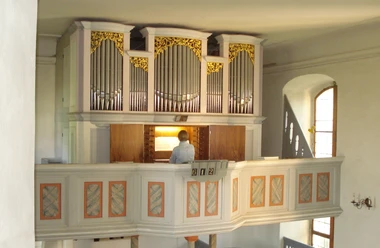
The Vogler organ in the church and the oldest mulberry tree in Germany on the church grounds are also worth seeing.
The wide Romanesque arch visible inside the church in the east wall of the tower dates from the time when the church was added in the form of a three-aisled basilica.
Conversions in the 15th century gave the interior its current appearance. The columns were removed, the clerestory windows were walled up and a ribbed vault was installed. One of the clerestory windows - located above the ribbed vault - has since been uncovered for viewing. It still has the wooden frame for fastening the parchment skin, which had to serve as "window glass" at the time. Incidentally, an old pillar remains - the Renaissance baptismal font stands on it in the choir square. The sacristy in the north wall of the choir square also dates from the 15th century. Here, fitted into the north apse wall, is a wooden gem - a cupboard made of long-fibered softwood, possibly the only original one from that time in the Free State of Saxony. The church chest with its five locks set into the floor of the sacristy and the medieval piscina also deserve our attention. The winged altar from the 15th century is particularly worth mentioning. While its front shows carved depictions of the story of Jesus and the life of Mary, the back features paintings of St. Martin, St. Catherine, St. Ursula and St. Mary Magdalene.
The Vogler organ in the church and the oldest mulberry tree in Germany on the church grounds are also worth seeing.
Good to know
Organization
Leipzig Tourismus und Marketing GmbH
License (master data)
Leipzig Tourismus und Marketing GmbH