Dreaming with Izabela Kaldunska while awake

Five questions for Izabela Kaldunska
Your Leipzig and good coffee?
I like it best at home. My favorite is classic coffee from an Italian espresso pot with soy milk and honey
Your Leipzig and bikes?
Biking is a big topic for me - I love getting around Leipzig by bike. Recently, I finally bought myself a proper road bike. Part of my work is also private tuition. I can ride my bike directly to the students' homes. I'm on the road for at least two hours a day. I like cycling to work, but I also like to cycle aimlessly in the evening - or to Lake Cospuden. That's my classic Leipzig bike ride.
Your Leipzig and culture?
I love all the small places on Eisenbahnstraße in the east of Leipzig. They mean a lot to me, because that's where we played gigs with my project The New Solarism and with my band Herje Mine. The more underground the better. And certainly Horn's Heirs. I played there, for example, with the Polish pianist Hania Rani, with Emily's Giant and many others.
Your Leipzig and architecture?
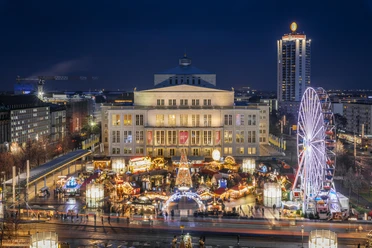
One building that has always been in my immediate vicinity because the university is just around the corner is the Federal Administrative Court. It's very impressive and so perfect in its classical appearance that I'm always happy to see it or walk past it. I even played there once in the golden hall - and the room really is golden! My second "favorite category" is old, dilapidated buildings - either old apartment buildings, which unfortunately are becoming increasingly rare in Leipzig, or old factories, such as the Krausefabrik in Anger-Crottendorf.
And what are you listening to right now?
Lately, I've been listening a lot to the Polish jazz band Immortal Onion. I can also recommend Deru. I like electronic music - somehow my taste in music has evolved from classical to electro.
<p
Izabela Kałduńska stands with her violin in the forest, City of Music Leipzig, Culture

Izabela's path to becoming a violinist
Izabela, how did you come to Leipzig?
I came here to study in 2009. I was 19 years old at the time. I knew the local professor, Roland Baldini from the Hochschule für Musik und Theater "Felix Mendelssohn Bartholdy" Leipzig, who runs music courses in Łańcut, Poland, every year. I liked and appreciated him so much that I wanted to study with him at some point.
What does an entrance exam look like?
I had just come from the music school in Gdańsk. I remember that I had played "Chaconne" by Bach, "Capriccio" by Paganini, a concerto by Sibelius, one by Mozart and "Phantasie" by Schönberg. Five of us made it in the end.
Did you know Leipzig beforehand?
No, I didn't even know where the city was! (Laughs) I was only in Leipzig once before the entrance exam. When I arrived, it felt like spring, even though it was still winter in Gdańsk.
What was your musical life like in Leipzig?
When you're studying, you're busy with concerts. At some point, exciting offers come along. I accepted them bit by bit, and so I was able to play with the Young German Philharmonic, for example. I didn't even have time to think about whether I wanted to stay in Leipzig because new projects were waiting for me all the time. Later, I got an internship at the Staatskapelle Halle. I was able to play in a professional orchestra for the first time. It was a full-time position and I learned what it means to make music professionally. After two years, I realized that this was not my life path. I had other musical interests and wanted to choose for myself what I did and didn't want to do.
Which path did you decide on?
I realized that playing in an orchestra wasn't my life goal. A fellow student asked me if I would like to play Balkan music. This music has always appealed to me - it is authentic, comes from the heart and immediately flows into the soul. I then started playing with the Balkan band Herje Mine. The first rehearsal was very fun, informal and relaxed. We played rhythms that I had to get used to, but after a few months it was okay. After every concert we got new requests and this summer we were even supposed to play at two bigger festivals, the FOLKLORUM and the Rudolstadt Festival. Unfortunately, the latter was canceled due to corona.
You also have a solo project now. Would you like to tell us a bit more about it?
The New Solarism is the result of all the musical currents I've been involved with so far. There are a lot of classical influences in it, but also contemporary music. When I was little, I always liked to play my own music. However, the more I played in orchestras, the more this desire was forgotten. Fortunately, it came back when I studied jazz violin as a minor with Thomas Prokein. Thomas showed me the Loop Station and introduced me to the world of improvisation. He taught me that I shouldn't be afraid of it or my own compositions. Herje Mine also helped me, because we also improvised a lot there. When you have a band, it's often difficult to plan concerts because everyone has their own daily routine and it's hard to get everyone under one roof. So I thought that I needed my own project that wasn't dependent on anyone else but myself.
How did you come up with the name The New Solarism?
The title is pure coincidence - with my other projects, we were simply looking for names. The New Solarism touched me. Literally, it is a theory about the origin of the sun. I thought it might help the listener to stimulate their imagination. I don't want to explain anything - it's meant to give the listener an impulse to think about things. Just like every piece of music in my album. You're supposed to be somewhere between dreaming and being awake.</p

Izabela-Kałduńska covers her violin with both arms and has her eyes closed, City of Music Leipzig, Culture


Izabela has just finished recording her first solo albumThe New Solarism - Studies Of Myself . Soon you will be able to listen to how the young violinist from Gdańsk musically dreams while awake. But before that, we invite you to listen online on 17.12.2020 to Izabela's symphony, which she composed on behalf of the Leipzig Philharmonic Orchestra as part of the Beethoven Year. You can listen to the livestream The New Solarism Orchestrated // Deconstruction | Reconstruction from Leipzig's Kupfersaal directly on the YouTube channel of The New Solarism.