Hidden Leipzig: Simsonplatz in the music district

People are creative here
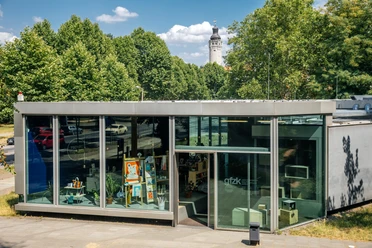
The music district is bursting with creative young minds who cavort in front of the art academies. The small district is home to the Hochschule für Grafik und Buchkunst, one of the oldest state art academies in Germany. The HGB has produced a number of artists. The most famous graduate is Neo Rauch. The writers of tomorrow hone their works in the white villa opposite the HGB. The Deutsches Literaturinstitut is a university school for writers, which has trained the Leipzig bestselling author Clemens Meyer, for example. Another hotbed of artists in the music district is the Hochschule für Musik und Theater. You can end your stroll through the creative music district at the Gallery of Contemporary Art. After viewing the current exhibition, it's time for a break in the in-house café. It is regularly redesigned and renamed by artists. Coffee is currently served in the bau bau. With a view of Johannapark, of course.
Our recommendations

There is something to admire here
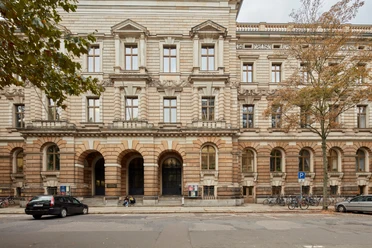
As you stroll through the Musikviertel, don't forget to take a look at the beautiful houses and villas. Housing construction in the Musikviertel began in the mid-1880s. Most of the buildings correspond to one of the neo-styles of historicism (neo-renaissance or neo-baroque) and resemble the large public buildings in the district. Don't miss the Roßbach-Eckhaus (Beethovenstraße 8) in the Neo-Renaissance style. The so-called Roßbach Palais was designed by the architect of the Bibliotheca Albertina and completed in 1893. You will also find Art Nouveau buildings that were built after 1900. There were detailed regulations for the development of the area, such as building height, building spacing, number of storeys and degree of overbuilding on the plots. The city council was also responsible for approving the façade view. As a result of all these regulations, the music district has many architectural gems and is a protected monument.
Relax here
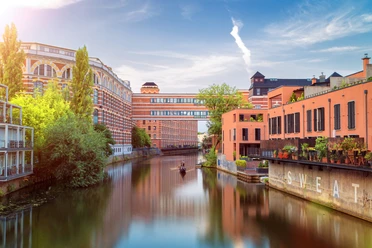
When the sun is shining, the Freisitz am Mendelssohnufer between Mozartstraße and Beethovenstraße is a popular place to relax, lie on the grass, drink coffee and unwind. If you sit down on the steps on the bank of the Pleißemühlgraben, you can even dip your feet in the water when the weather is nice. But that wasn't always the case. In 1951, a large part of the ditch was covered with an arched pipeline due to the heavy water pollution from the lignite industry. After the situation had eased, the motto from 1990 was "Pleiße to the light". Work began to uncover and shape the Pleißemühlgraben again. Today you can sit there again and relax. With the magnificent Federal Administrative Court behind you. There are worse views, right?
Our recommendations

Cramming here
In the past, the district was characterized above all by its musical tradition. Today, the streets are full of students. This is mainly due to the fact that the Humanities Center of Leipzig University and the Bibliotheca Albertina in Beethovenstraße are located directly opposite each other. The two buildings form a kind of student mecca. The bicycle stands on both sides of the street are packed, especially at exam times. When the students aren't studying until their heads are spinning, they sit on the steps in front of the Albertina with coffee and club mate. A short break is a must before heading back into the glamorous halls of Leipzig University Library. The library is open to everyone and should be a stop on your exploration tour of the district for the beautiful entrance hall alone. Are you a bookworm? Find more libraries in Leipzig here. In the next section, you can read where not only students like to relax in the district.

Staircase in the Albertina Library - University of Leipzig

Our recommendations

This is where the music plays
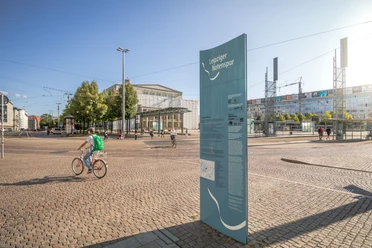
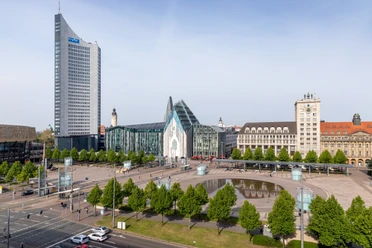
Is the music district called that because many street musicians perform there? Or is it a popular place for musicians to live? All wrong! Musikviertel is actually just an unofficial name for the residential area in Leipzig's Südwestvorstadt district. Important Leipzig music institutions are responsible for the name. The first buildings in the district were the second Gewandhaus, then called the Neues Concerthaus, in 1884 and the new building of the Königliches Konservatorium der Musik in 1887. Robert and Clara Schumann and Felix Mendelssohn-Bartholdy wrote music history here. Unfortunately, the Gewandhaus and the conservatory were destroyed in an air raid in 1944. Today, students cram at Leipzig University's Humanities Center on the site of the former Gewandhaus. Despite the destruction, the Leipziger Notenspur lets you follow in the footsteps of the musicians. Music has not only shaped the district's past. To this day, many streets bear the names of musicians.

Leipzig Tourismus und Marketing GmbH
Augustusplatz 9
04109 Leipzig
Tel +49 (0)341 7104-340
www.leipzig.travel
social.media@ltm-leipzig.de