Friderici organ in the Ev.-Luth. Katharinenkirche Großdeuben


The Italianized spelling of the name Friedrich has survived in two different variants: Friederici and Friderici. Christian Ernst Friderici (1709 - 1780) is regarded as the most important master of the firm founded by Johannes Friderici (1653 - 1780). In 1737 Christian Ernst Friedrich Friderici was granted citizenship in Gera. He was still working in the spirit of the universal "instrument makers", such as Silbermann and Hildebrandt. From 1740 onwards, he mainly worked on stringed keyboard instruments.
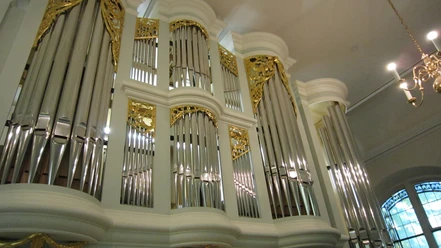
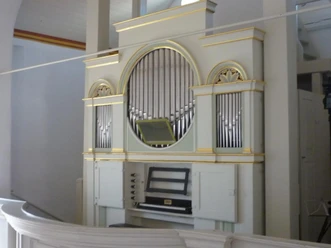
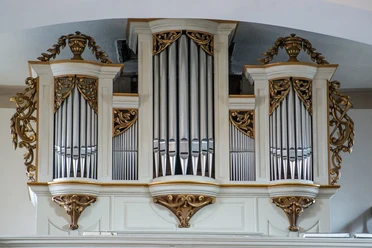
He built the Großdeuben organ in 1754/55 for the church in Cröbern. After Cröbern had to make way for open-cast mining, the organ was moved to Großdeuben in 1972/73 by the organ building company Eule.
Church:
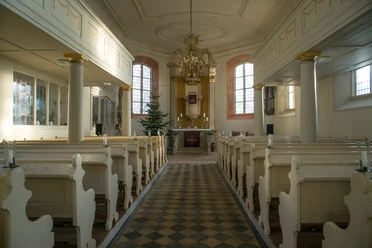
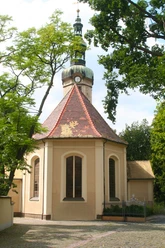
The current baroque hall church was built in 1716 on the same site as an earlier church. In 1888, a sacristy was added, today's "Lutherstube". In connection with the redesign of the church in Art Nouveau style in 1906, an extension was added on the west side. The pulpit altar and the baptismal lectern are part of the 1716 furnishings. A shrine from a late Gothic carved altar is kept in the "Lutherstube". It comes from the former church in Zehmen The numerous epitaphs are partly from the previous building. The current painting corresponds again to the Art Nouveau style of 1906. The Friderici organ from Cröbern from 1754/55 has stood in the west gallery since 1973 I/15
Text: Klaus Gernhardt
Further reading:
- Ulrich Dähnert, Historische Orgeln in Sachsen, VEB Deutscher Verlag für Musik
Leipzig, 1980
- Georg Dehio, Handbuch der Deutschen Kunstdenkmäler, Sachsen II,
Deutscher Kunstverlag, 1998
- Lexikon norddeutscher Orgelbauer, Band 2, Sachsen und Umgebung,
Pape Verlag Berlin, 2012
He built the Großdeuben organ in 1754/55 for the church in Cröbern. After Cröbern had to make way for open-cast mining, the organ was moved to Großdeuben in 1972/73 by the organ building company Eule.
Church:
The current baroque hall church was built in 1716 on the same site as an earlier church. In 1888, a sacristy was added, today's "Lutherstube". In connection with the redesign of the church in Art Nouveau style in 1906, an extension was added on the west side. The pulpit altar and the baptismal lectern are part of the 1716 furnishings. A shrine from a late Gothic carved altar is kept in the "Lutherstube". It comes from the former church in Zehmen The numerous epitaphs are partly from the previous building. The current painting corresponds again to the Art Nouveau style of 1906. The Friderici organ from Cröbern from 1754/55 has stood in the west gallery since 1973 I/15
Text: Klaus Gernhardt
Further reading:
- Ulrich Dähnert, Historische Orgeln in Sachsen, VEB Deutscher Verlag für Musik
Leipzig, 1980
- Georg Dehio, Handbuch der Deutschen Kunstdenkmäler, Sachsen II,
Deutscher Kunstverlag, 1998
- Lexikon norddeutscher Orgelbauer, Band 2, Sachsen und Umgebung,
Pape Verlag Berlin, 2012
Disposition
Manual range C, D - c'''
1. Principal 8'
2. Gedackt 8'
3 Viola di Gamba 8'
4. Qintatöna 8'
5. Principal 4'
6. Rohrflöte 4'
7. Quinte 3'
8. Octave 2'
9. Quinte 1 1/2'
10. Super Octave 1'
11. Cornett 3fach (from c')
12. Mixtur 3fach
Pedal range C,D - c'
13. Subbass 16'
14. Octave bass 8'
15. Trombone bass 16'
Pedal coupler
Tremulant (Eule, 1948)
Pitch a' 465 Hz
Good to know
Openings
- Opening hours refer to the parish office
Eligibility
Bad Weather Offer
Suitable for any weather
for Groups
for individual guests
Suitable for the Elderly
Directions & Parking facilities
- By public transport: To Markkleeberg-Gaschwitz S-Bahn station. Continue with bus line 107 to the bus stop Großdeuben (Böhlen), Martin-Luther-Str.
Alternatively: Take the S5 to Großdeuben S-Bahn station. From there, 9 min. walk (585 m). Organization
Leipzig Tourismus und Marketing GmbH
License (master data)
Leipzig Tourismus und Marketing GmbH