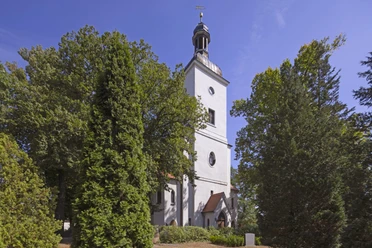
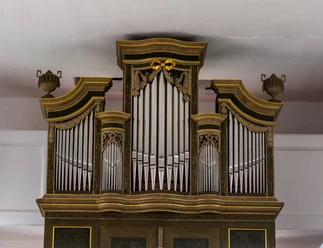
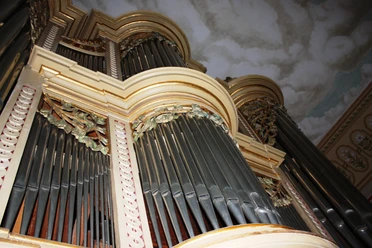
Geißler organ in the Frauenkirche Groitzsch

Conrad Geißler (1825 - 1897) ran his own workshop in Eilenburg from 1852 to 1897 after completing his apprenticeship and working as an assistant with Weineck, Mende, Ladegast and Walcker. During this time, he built around 120 organs. There was a close relationship between Ladegast and Geißler even after Geißler worked for Ladegast. Between 1864 and 1873, he built four organs on his behalf. He built his largest organ with three manuals and 44 stops for the town church in Torgau (no longer preserved). In 1885 he built the two-manual organ in Groitzsch with mechanical action and slider windchests. II/17.2007 a general overhaul was carried out by the company Bochmann, Kohren-Sahlis.
Text: Klaus Gernhardt
Disposition
Main organ (C-f'')
1 Bordun 16'
2 Principal 8'
3 Hohlflöte 8'
4 Oktave 4'
5 Gemshorn 4'
6 Oktave 2'
7 Quinte 1 1/3'
8 Mixtur 3fach
Oberwerk (C-f''')
9 Gedackt 8'
10 Principal 4'
11 Waldflöte 2'
12 Schwiegel 1'
13 Sesquialter 2fach
Pedal (C-d')
14 Violon 16'
15 Subbass 16'
16 Principalbass 8'
17 Choralflöte 4'
Manual coupler
Pedal coupler
Good to know
Directions & Parking facilities
- By car: Follow the B2 to Pegau. Drive to Wiesengasse in Groitzsch
By public transport: Take the RE12 or RB 13 to Pegau and continue on bus line 271 to Groitzsch (b. Pegau), Markt. Social Media
Organization
Leipzig Tourismus und Marketing GmbH
License (master data)
Leipzig Tourismus und Marketing GmbH