Jehmlich organ in the Paulinum

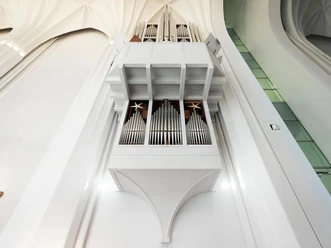
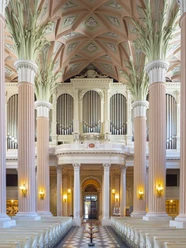
The Jehmlich organ on the west gallery was built in the years 2016 and 2017 and takes in an innovative way on the 1717 by Bach tested baroque organ Johann Scheibes reference, at that time one of the most modern organ works of its time. After 1800 it was redesigned several times in line with Romantic ideas of sound : beginning by Johann Gottlob Trampeli (1803) and Johann Gottlob Mende (1821) through to the new building, also by Mende (1846) and the renewed fundamental reconstruction by Friedrich Ladegast (1873). The new organ with its 46 stops was designed for a wide range of repertoire and is particularly suitable especially for works by the great Leipzig Bach, Mendelssohn and Reger, but also for later music up to the present day.
From "Thoughts on the new organ building in the Paulinum Leipzig by Ralf Jehmlich" (abridged)
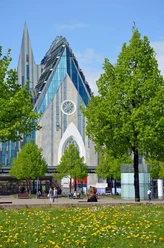
The newly built Paulinum in Leipzig, on the site of the university church that existed until 1968, is a living and obvious link between the present and a past rich in tradition. The emotional, highly eventful history is summarized by the Leipzig University management in the mission statement "Crossing borders out of tradition".
The sound stylistic concept is primarily oriented towards German organ music of the 18th century, but also takes into account compositions of later eras through color-differentiated basic voices. The organ is suitable for works by Johann Sebastian Bach, Felix Mendelsohn Bartholdy and Max Reger, as well as for later music up to the present day.
The organ's sound body, which is designed with 46 stops on 3 manuals and pedal and a total of 2951 pipes, was given appropriately wide scales to suit the acoustics of the room.
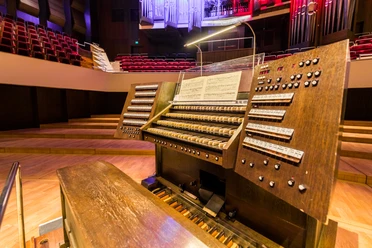
The organist has both a mechanical and an electric action at his disposal. The key action is a double action (electric and mechanical). The electric stop control is equipped with a stoplist system with a memory capacity for 30,000 combinations and touch-screen operation. In addition to freely programmable stop crescendi, the sound dynamics of the organ can be shaped with two swellable manual stops. The requirements for continuo playing for the interpretation of works from earlier eras were also met by the Brustwerk, which can be transposed up and down by a semitone, and 3 corresponding Pedal stops. The electric action enables a freely programmable interval coupler and coupler system. A MIDI interface, which allows the storage and playback of recorded melodies and improvisations, as well as a note printout and the control of external sound generators, round off the technical possibilities of the organ.
The inner work structure is arranged in 3 levels and takes up a space of 7m wide, 4m deep and 11m high. The swellable Brustwerk is located directly above the console with visible swell shutters in the façade. The Hauptwerk is arranged in the middle as the central movement, with the swellable Oberwerk above it. The large swell shutters of the Oberwerk are not visible from the church interior. This staggered arrangement of the 3 manual divisions allows for equal sound radiation into the room.
The exterior design of the organ was developed in close collaboration with architect Dr. Klausjürgen Schöler and in consultation with architect Erick van Egeraat. The organ case was finished in white lacquer to match the interior architecture. The console was designed in cherry wood. With 56 visible façade pipes of the main voices of the Great Principal 16' and Pedal Trombone 16' stops, the organ façade is vertically divided into 7 slender fields.
Disposition
I. BRUSTWERK HH - b3
1. Holzgedackt 8′
2. Quintadena 8′
3. Salicional 8′
4. Principal 4′
5. Rohrflöte 4′
6. Nasat 2⅔′
7. Octave 2′
8. Terzflöte 1⅗′
9. Larigot 1⅓′
10. Scharf IV 1′
11. Krummhorn
Tremulant 8′
II. MAIN WORK C - a3
12. major principal 16′
13. minor principal 8′
14. flûte allemande 8′
15. gemshorn 8′
16. octave 4′
17. pointed flute 4′
18. fifth 2⅔′
19. Qktava 2′
20. cornet V 8′
21. great mixtur V 2′
22. bassoon 16′
23. trumpet 8′
III. OBERWERK C - a3
24. bourdon 16′
25. principal 8′
26. hollow flute 8′
27. Viola da gamba 8′
28. lamento 8′
29. octave 4′
30. transverse flute 4′
31. fugara 4'
32. philomela 2'
33. piccolo 1′
34. mixtur III-VI 2′
35. Hautbois
Tremulant 8′
PEDAL C - g1
36. Untersatz 32′
37. Great Principal Bass
(Transmission of 12.) 16′
38. Violon 16′
39. Subbass
(Extension of 36.) 16′
40. Octave
(Transmission of 12th) 8′
41. cello
(Extension of 38th) 8'
42. drone
(Extension of 36th) 8′
43. wide octave 4'
44. trombone 16'
45.Trumpet
(Extension of 44.) 8′
46.Trumpet 4′
COPELS AND PLAYING AIDS
Normal couplers: I/II, III/II, III/I, I/P, II/P, III/P (mech. + electric)
Suboctave couplers: III/I, III/II (electric)
Superoctave couplers: III/II, III/P (electric)
Pistons:
Normal couplers I/II, III/II, III/I, I/P, II/P, III/P
General coupler
Manual stop to roll
Couplers from roll
Sequencer (<,>)
Crescendo on
Tutti
Crescendo roll, swell step BW, swell step OW
Voice pitch a1 = 440 Hz at 21°C
Transposing device 415/440/465 Hz
MIDI interface
From "Thoughts on the new organ building in the Paulinum Leipzig by Ralf Jehmlich" (abridged)
The newly built Paulinum in Leipzig, on the site of the university church that existed until 1968, is a living and obvious link between the present and a past rich in tradition. The emotional, highly eventful history is summarized by the Leipzig University management in the mission statement "Crossing borders out of tradition".
The sound stylistic concept is primarily oriented towards German organ music of the 18th century, but also takes into account compositions of later eras through color-differentiated basic voices. The organ is suitable for works by Johann Sebastian Bach, Felix Mendelsohn Bartholdy and Max Reger, as well as for later music up to the present day.
The organ's sound body, which is designed with 46 stops on 3 manuals and pedal and a total of 2951 pipes, was given appropriately wide scales to suit the acoustics of the room.
The organist has both a mechanical and an electric action at his disposal. The key action is a double action (electric and mechanical). The electric stop control is equipped with a stoplist system with a memory capacity for 30,000 combinations and touch-screen operation. In addition to freely programmable stop crescendi, the sound dynamics of the organ can be shaped with two swellable manual stops. The requirements for continuo playing for the interpretation of works from earlier eras were also met by the Brustwerk, which can be transposed up and down by a semitone, and 3 corresponding Pedal stops. The electric action enables a freely programmable interval coupler and coupler system. A MIDI interface, which allows the storage and playback of recorded melodies and improvisations, as well as a note printout and the control of external sound generators, round off the technical possibilities of the organ.
The inner work structure is arranged in 3 levels and takes up a space of 7m wide, 4m deep and 11m high. The swellable Brustwerk is located directly above the console with visible swell shutters in the façade. The Hauptwerk is arranged in the middle as the central movement, with the swellable Oberwerk above it. The large swell shutters of the Oberwerk are not visible from the church interior. This staggered arrangement of the 3 manual divisions allows for equal sound radiation into the room.
The exterior design of the organ was developed in close collaboration with architect Dr. Klausjürgen Schöler and in consultation with architect Erick van Egeraat. The organ case was finished in white lacquer to match the interior architecture. The console was designed in cherry wood. With 56 visible façade pipes of the main voices of the Great Principal 16' and Pedal Trombone 16' stops, the organ façade is vertically divided into 7 slender fields.
Disposition
I. BRUSTWERK HH - b3
1. Holzgedackt 8′
2. Quintadena 8′
3. Salicional 8′
4. Principal 4′
5. Rohrflöte 4′
6. Nasat 2⅔′
7. Octave 2′
8. Terzflöte 1⅗′
9. Larigot 1⅓′
10. Scharf IV 1′
11. Krummhorn
Tremulant 8′
II. MAIN WORK C - a3
12. major principal 16′
13. minor principal 8′
14. flûte allemande 8′
15. gemshorn 8′
16. octave 4′
17. pointed flute 4′
18. fifth 2⅔′
19. Qktava 2′
20. cornet V 8′
21. great mixtur V 2′
22. bassoon 16′
23. trumpet 8′
III. OBERWERK C - a3
24. bourdon 16′
25. principal 8′
26. hollow flute 8′
27. Viola da gamba 8′
28. lamento 8′
29. octave 4′
30. transverse flute 4′
31. fugara 4'
32. philomela 2'
33. piccolo 1′
34. mixtur III-VI 2′
35. Hautbois
Tremulant 8′
PEDAL C - g1
36. Untersatz 32′
37. Great Principal Bass
(Transmission of 12.) 16′
38. Violon 16′
39. Subbass
(Extension of 36.) 16′
40. Octave
(Transmission of 12th) 8′
41. cello
(Extension of 38th) 8'
42. drone
(Extension of 36th) 8′
43. wide octave 4'
44. trombone 16'
45.Trumpet
(Extension of 44.) 8′
46.Trumpet 4′
COPELS AND PLAYING AIDS
Normal couplers: I/II, III/II, III/I, I/P, II/P, III/P (mech. + electric)
Suboctave couplers: III/I, III/II (electric)
Superoctave couplers: III/II, III/P (electric)
Pistons:
Normal couplers I/II, III/II, III/I, I/P, II/P, III/P
General coupler
Manual stop to roll
Couplers from roll
Sequencer (<,>)
Crescendo on
Tutti
Crescendo roll, swell step BW, swell step OW
Voice pitch a1 = 440 Hz at 21°C
Transposing device 415/440/465 Hz
MIDI interface
Good to know
Author
Leipzig Tourismus und Marketing GmbH
Grimmaischen Steinweg 804103 LeipzigOrganization
Leipzig Tourismus und Marketing GmbH