Swallow's nest organ in the Paulinum

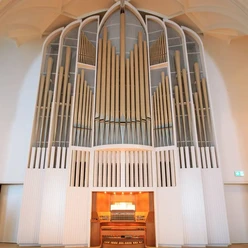
The Schwalbennest organ at the University of Leipzig owes its creation to the commitment of Prof. Dr. Winfried Schrammek (†), who pointed out the description of the Pauline organ in Michael Praetorius. In his "Syntagma musicum II" from 1619, an organ from around 1527 is listed. Samuel Scheidt accepted this instrument, which was presumably reworked by Ibach and probably contained older components from a previous instrument. His report states "... the tremulant, which according to all organists is a noble and principal piece of work..."
The Schwalbennest organ was designed on the basis of the disposition mentioned by Praetorius.
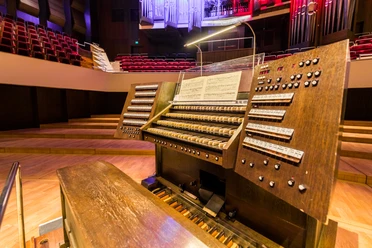
The Schwalbennest organ is divided into Oberwerk, Unterwerk, Brustwerk and Pedal on two manuals and pedal. The Messing Regall 8' of the Brustwerk is played from the second keyboard (Oberwerk). The Oberwerk ranges from the singing Great Principal 16' in the façade to the 12-fold mixture, in which the concept of the late medieval Blockwerk is still present. The pedal takes over two transmissions from the Oberwerk (Großprinzipal 16' and Prinzipal 8') and adds three stops of its own (Posaune 16', Subbass 16'; Cornet 2' as sound crown). The case closes under the Unterwerk with an elegantly curved Cul de Lampe. Here you will find the richly colored stops Cimbalom 2' (with frequent, high repetitions) and Small Octave 1', which enable the variously shimmering gap registrations of the Renaissance organ.
The manual and pedal keyboards are designed with a short octave.
The 12-rank mixture, executed without repetitions with increasing choirs on a 4' basis from 7-12 ranks, was just as exciting a project as the "Groß blechen Kälber Regal", for whose construction there was no tradition.
The lush battery of effect stops invites humorous and surprising playing possibilities in liturgy and organ literature.
With the new Metzler organ, in the very diverse Leipzig organ landscape a still stylistic gap has been closed: As an instrument tuned consistently with radiantly pure thirds with the typical tonal richness of the Renaissance organ it is besides its liturgical tasks for the interpretation of organ music of the 16th and 17th centuries. and 17th century best suited. Music from the late Gothic period and works from the 18th century that can be performed in the middle register or contemporary compositions and improvisations also come into their own here.
The instrument was available between 2015 and 2021 in a first expansion stage, consisting of seven sounding stops, tremulant and Vogelsang. In September 2021, the organ was completed with 11 additional stops. The result is a work of outstanding craftsmanship, technology and sound. Since then, the Schwalbennest organ has delighted audiences with the purity of its sound, its joy of playing, the wide range of colorful registration possibilities and its extensive combinability with vocal-instrumental constellations. In choral work, the midrange has a very positive effect on the intonation.
Disposition
OBERWERK
Großprinzipal 16' (in the facade) Prinzipal 8'
Oktave 4'
Rohrflöte 8' Quinta 3'
Superoctava 2'
Mixtur 7-12-fach Rauschpfeif-Zimbeln 2f.
Brass regall 8' in the chest
UNTERWERK
Principal 4' (in the prospectus) Grobgedackt 8'
Mittelgedackt 4'
Klein Octävelein 1'
Cymbals 2f.
Groß blechen Kälber Regal 8'
PEDAL
Großprinzipal 16' (Transmission OW)
Prinzipal 8' (Transmission OW)
Subbass 16'
Trombones 16'
Cornet 2'
2 Zimbelsterne
Bell wheel (tread)
Tambour (tread)
Vogelsang
Tremulant
Couplers UW-OW, UW-P, OW-P
Midrange temperament(1/6 comma)
Short octave
a1 = 465 Hz.
2 scoop bellows
The Schwalbennest organ was designed on the basis of the disposition mentioned by Praetorius.
The Schwalbennest organ is divided into Oberwerk, Unterwerk, Brustwerk and Pedal on two manuals and pedal. The Messing Regall 8' of the Brustwerk is played from the second keyboard (Oberwerk). The Oberwerk ranges from the singing Great Principal 16' in the façade to the 12-fold mixture, in which the concept of the late medieval Blockwerk is still present. The pedal takes over two transmissions from the Oberwerk (Großprinzipal 16' and Prinzipal 8') and adds three stops of its own (Posaune 16', Subbass 16'; Cornet 2' as sound crown). The case closes under the Unterwerk with an elegantly curved Cul de Lampe. Here you will find the richly colored stops Cimbalom 2' (with frequent, high repetitions) and Small Octave 1', which enable the variously shimmering gap registrations of the Renaissance organ.
The manual and pedal keyboards are designed with a short octave.
The 12-rank mixture, executed without repetitions with increasing choirs on a 4' basis from 7-12 ranks, was just as exciting a project as the "Groß blechen Kälber Regal", for whose construction there was no tradition.
The lush battery of effect stops invites humorous and surprising playing possibilities in liturgy and organ literature.
With the new Metzler organ, in the very diverse Leipzig organ landscape a still stylistic gap has been closed: As an instrument tuned consistently with radiantly pure thirds with the typical tonal richness of the Renaissance organ it is besides its liturgical tasks for the interpretation of organ music of the 16th and 17th centuries. and 17th century best suited. Music from the late Gothic period and works from the 18th century that can be performed in the middle register or contemporary compositions and improvisations also come into their own here.
The instrument was available between 2015 and 2021 in a first expansion stage, consisting of seven sounding stops, tremulant and Vogelsang. In September 2021, the organ was completed with 11 additional stops. The result is a work of outstanding craftsmanship, technology and sound. Since then, the Schwalbennest organ has delighted audiences with the purity of its sound, its joy of playing, the wide range of colorful registration possibilities and its extensive combinability with vocal-instrumental constellations. In choral work, the midrange has a very positive effect on the intonation.
Disposition
OBERWERK
Großprinzipal 16' (in the facade) Prinzipal 8'
Oktave 4'
Rohrflöte 8' Quinta 3'
Superoctava 2'
Mixtur 7-12-fach Rauschpfeif-Zimbeln 2f.
Brass regall 8' in the chest
UNTERWERK
Principal 4' (in the prospectus) Grobgedackt 8'
Mittelgedackt 4'
Klein Octävelein 1'
Cymbals 2f.
Groß blechen Kälber Regal 8'
PEDAL
Großprinzipal 16' (Transmission OW)
Prinzipal 8' (Transmission OW)
Subbass 16'
Trombones 16'
Cornet 2'
2 Zimbelsterne
Bell wheel (tread)
Tambour (tread)
Vogelsang
Tremulant
Couplers UW-OW, UW-P, OW-P
Midrange temperament(1/6 comma)
Short octave
a1 = 465 Hz.
2 scoop bellows
Good to know
Author
Leipzig Tourismus und Marketing GmbH
Grimmaischen Steinweg 804103 LeipzigOrganization
Leipzig Tourismus und Marketing GmbH